
This article is the second in a series on kitchen labor, accountability, and reform. You can read the first on culinary education and award bodies here.
In 2024, New York State passed the Retail Worker Safety Act to better equip its workforce for aggressive and problematic behavior on the job. The informational video for the program uses a restaurant façade to illustrate applicable businesses, but the law itself explicitly excludes restaurants. This exclusion from mandatory workplace violence prevention is a deliberate choice—and one that can be changed.
Restaurants are the second-largest private employer in New York State and are operating without a healthy and consistent way to protect employees’ well-being and mitigate any problematic behavior. Restaurant violence has two main sources: the first is customer-on-employee violence (For example, aggression around alcohol or threats over refused service) and the second type would be violence between coworkers and/or employers (For example, an abusive chef or retaliation from a manager). Documented abuse like this has long been normalized as a part of the industry.
New York has already built the tool to address this. Retailers with more than ten employees must adopt a prevention policy, provide prevention training, and provide a risk assessment of the workplace. Risk assessments can include: “Employer review of worker and police reports of incidents of assault or aggressive behavior from the past two years” or “Solicitation of worker feedback on their experience of violence or aggressive behavior and areas of risk within the store.” Retailers with more than 500 employees must provide a “silent response button” and training for said button. The NYS Department of Labor’s website includes a policy model, additional tips for training, and encourages a violence “report system.” Training must be provided every one to two years.
According to the act, a “retail store” is “a store that sells consumer commodities at retail and which is not primarily engaged in the sale of food for consumption on the premises.” This is a line that has gone unchanged since the bill’s original version, introduced in January of 2024.
When I reached out to the Retail, Wholesale and Department Store Union (RWDSU) for comment, a main advocate for the act, they referred to the RWSA as “our bill” and that “the ideas and preliminary language from the bill came from us based on the experiences of our members in the stores” and that the RWDSU had collaborated with “labor partners, consumer groups, faith groups, etc. to garner their support for the bill.” While the RWDSU has organized with those involved with the restaurant industry (such as the She Wolf Workers Union), they were not included as an example of an at-risk worker in the justification for the bill. Instead, it highlighted jobs such as grocery store workers who are “targeted for racially motivated mass-shootings,” particularly in the wake of the Tops Supermarket shooting in Buffalo in 2022. It seems like restaurant workers weren’t cut in the negotiation, rather they were never considered because there weren’t advocates representing them.
The DOL’s downloadable policy model and training videos include information that is more than relevant to restaurants. The model establishes situations that pose the greatest risk for employees (working late at night, the sale of alcohol, and exchanging money) and even the people —one of them being “Current or past employees,” in addition to strangers and customers. This video even shares de-escalation tactics. Ironically, the model points to “a lack of staff training on recognizing hostile and aggressive behavior” as one of the factors that may increase workplace violence. It’s paradoxical to be concerned with a lack of staff training and then neglect an industry known for its cycles of abuse.
The State’s penal law also undercuts the RWSA’s exclusion of restaurant workers by recognizing them as retail workers. It defines retail establishments as “any physical business or commercial entity engaged in the sale of goods, merchandise, or services directly to consumers.” It also classifies assault against retail workers, including restaurant workers, as class E felony. In other words, New York State recognizes restaurant workers face the same increased threats of violence as other retail workers when it comes to punishing it, but not when preventing that same violence. This also means retail workers face enough violence in New York that it warranted its own criminal penalty, which is exactly why they should extend preventative requirements to restaurants with so many of the same risky circumstances.
However, a lack of protections for restaurant workers is part of a larger oversight. The NY State and City governments fail restaurant workers on multiple levels: there are public wellness programs for hospitality (such as ELEVATE from the Office of Nightlife), but restaurants are not required to post this information on signs or inform their employees about them; restaurant resources, permits, and requirements are scattered across “an alphabet soup of government agencies,” as NYC Hospitality Alliance Executive Director Andrew Rigie put it; and the only federal guidelines are OSHA’s violence training “recommendations” packet intended for “late-night retail establishments,” but has no restaurant-specific support and has not been updated since 2009—which means there isn’t much of a federal guardrail.
Protections for restaurant workers in New York are long overdue and the easiest place to start is including food-service in the RWSA. Expanding the bill to include restaurant owners, employees, and employers would be low-lift as many of the resource guides, templates, and videos are accessible on the NY State website, free and in multiple languages. Voluntary models also show similar interests, such as the former Wursthall’s “no cursing” policy in San Mateo and Chicago’s CHAAD, which documents abuse in addition to educating hospitality workers on industry-tailored resources. Some young chefs are asking for the same preventative measures to become standard in restaurant kitchens. An extra hour every one-to-two years to train staff on violence prevention isn’t a waste of time or resources—in fact, fosters a more efficient business in the long run.
This gap does not affect every restaurant worker equally. The majority of restaurant workers in the U.S. are racial and ethnic minorities, yet when the Southern Smoke Foundation, which offers free mental health services to food and beverage workers, reported on who actually used its services in 2025, the majority of clients were white. Racial and ethnic minorities specifically make up an even higher ratio in kitchens. This suggests the staff most likely to experience abuse are the ones least likely to seek out support and are exactly who a mandate would help protect. This, coupled with how Brooklyn was Southern Smoke’s top client location in 2025, is a sign of how much demand already exists here.
New York has a chance to be at the forefront of stopping the cycles of abuse in restaurants. And with the Retail Worker Safety Act, that reform could be easier than ever. The state has already decided restaurant workers are retail workers when they’re assaulted. Now it just needs to decide they are retail workers before that happens. •
Jaden Schapiro is a senior writer and researcher at the Hunter College New York City Food Policy Center.
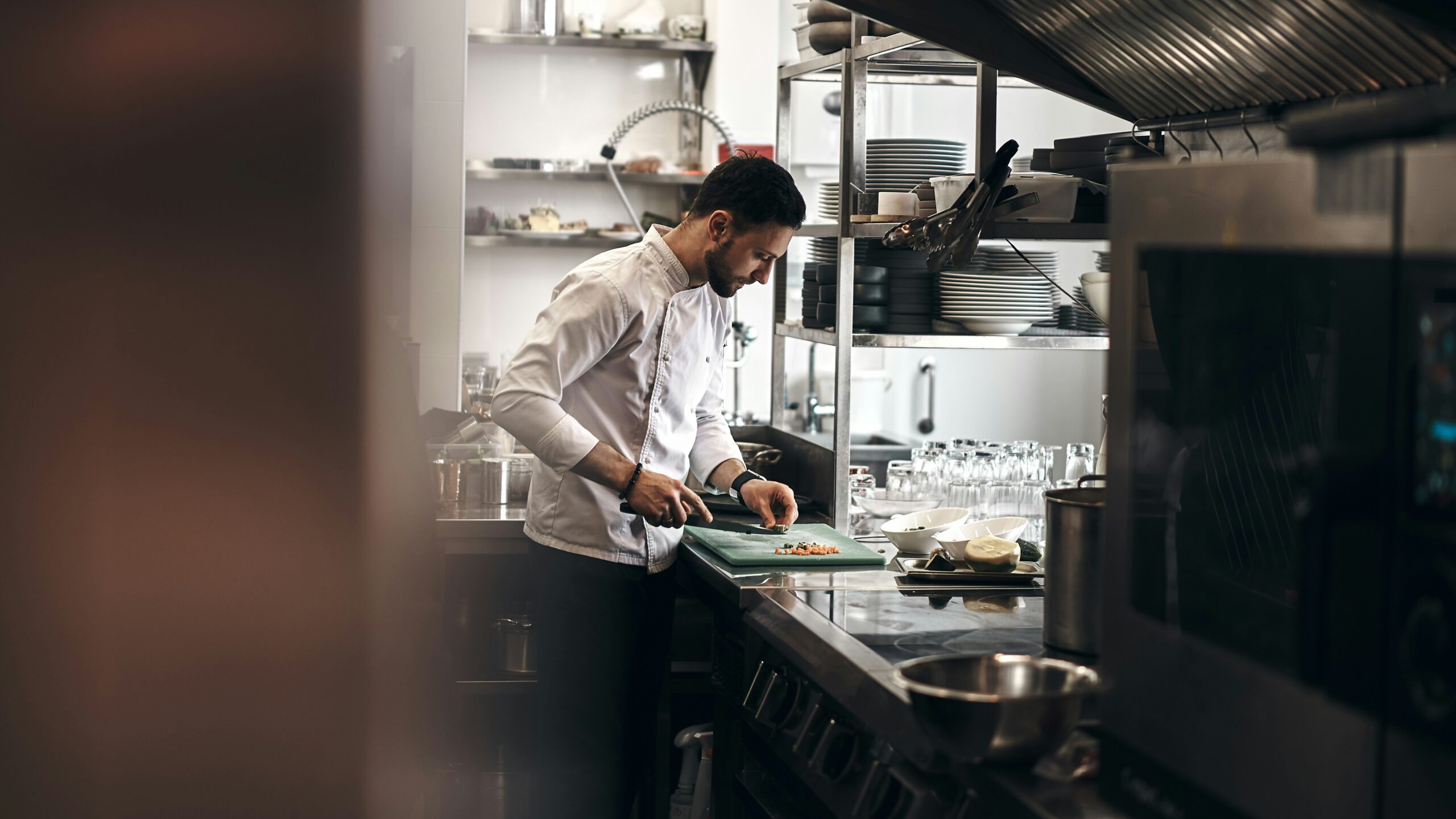
Cover art by Pylyp Sukhenko via Unsplash.