For hundreds of thousands of New Yorkers, the food pantry has long been the backstop of last resort—a place to turn when wages, benefits, or both fall short of what groceries cost. But the pantry model, built around fixed sites and pre-packed bags, is increasingly straining against a level of need it was never designed to absorb. Now the City is asking whether that model should be reimagined altogether.
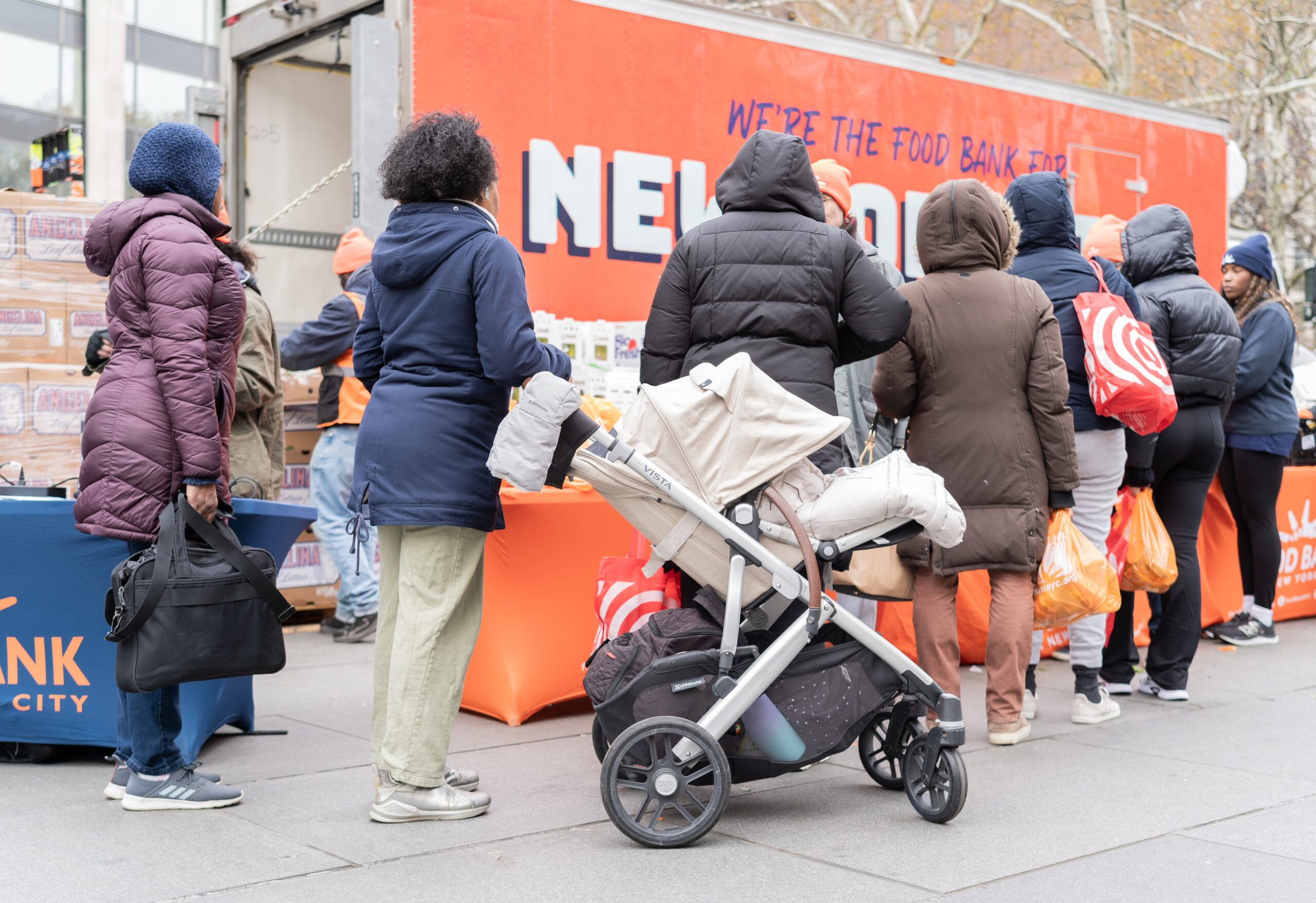
That strain reflects a deeper shift in who relies on emergency food, and how often. Pantry use across the city now runs roughly twice as high as it did before the pandemic, and the people in line increasingly include New Yorkers who are employed: the share of working New Yorkers visiting pantries climbed from about 5 percent in 2019 to 11 percent in 2023, and roughly two in three pantry users had been working in recent years. City Harvest has reported that the pantries and soup kitchens in its network are seeing about one million more visits each month than before the pandemic. For a growing number of households, the pantry is no longer a one-time emergency measure but a weekly part of making ends meet.
The need behind those visits is both broad and persistent. In 2023, roughly one in three adults and nearly half of families with children in New York City experienced food hardship—defined as running out of food or uncertain access to it. Food Bank For New York City estimates that about 1.4 million New Yorkers, including one in four children, face food insecurity, and some 230 million pounds of emergency food were distributed across the five boroughs in 2023. Rising grocery prices, housing costs, and childcare expenses have combined to keep that demand elevated long after the acute crisis of the pandemic faded—leaving a sprawling pantry network carrying weight it was never built to bear, week in and week out.
Then the system’s fragility was laid bare. When a two-week interruption in Supplemental Nutrition Assistance Program (SNAP) payments hit in November 2025, the emergency food network absorbed the shock almost overnight. Some providers reported giving away three times their usual volume of food, while others saw demand spike by as much as 300 percent, and roughly one in five pantries had to turn people away after running out. The episode was temporary, but it exposed how little slack the system holds—and how quickly a disruption in federal benefits cascades onto pantry shelves.
In a joint effort, the New York City Department of Social Services (DSS) and the Mayor’s Office of Food Policy (MOFP) have launched the PantryLink Challenge, an open call inviting technologists and innovators to design a scalable, participant-centered pilot for a voucher or credit-based food assistance model—one that puts direct purchasing power in the hands of individuals rather than routing them through a pantry line.
“The PantryLink program recognizes how personal food is, and that what you choose to eat shouldn’t be limited when times are tough,” said Ora Kemp, a senior policy advisor at the Mayor’s Office of Food Policy. “Whether you’re managing a health condition and need to follow a special diet, or you need certain items to cook for a celebration, or you want to get your kids’ favorite snacks, this program is designed to empower you to choose how you feed yourself and your family.” The shift, as Kemp describes it, is fundamentally about autonomy—both for the organizations deciding how to spend their City funding and for the people they serve. “With vouchers or credit, PantryLink will afford our neighbors the ability to select their own groceries: foods that are familiar, that reflect their cultures and cooking traditions, that families will actually use to make nourishing, comforting meals,” she said. The result, in her words, is a food security network “with choice at its center.”
The Challenge sits atop an already vast infrastructure. At the center of the City’s emergency food system is DSS’s Community Food Connection (CFC) program, which funds more than 700 food pantries and soup kitchens across the five boroughs. That network has been a workhorse of the local safety net—but City officials have signaled that meeting today’s rising need will require more than scaling the existing approach.
According to the Challenge materials, the City is seeking “bold, tech-enabled solutions” built around five goals: empowering participant dignity and choice, improving nutritional and health outcomes, strengthening local retail ecosystems, increasing system efficiency, and generating actionable data and insight. In other words, the City wants a pilot that does more than feed people—it wants one that channels spending into neighborhood retailers and produces evidence about what works.
Part of the rationale is operational. Through CFC, Kemp explained, the City provides more than $50 million a year to organizations as a line of credit they use to order approved items from a contracted food vendor. That list can be adjusted at providers’ request, but doing so “often requires additional time to identify a source, ensure it aligns with the city’s food standards, update the ordering list, and make the product available to providers.” A voucher or credit model, by contrast, would let community organizations and the families they serve respond to need directly. The 2025 SNAP disruption sharpened the case. In the episode, Kemp said, “[the disruption] illuminate[d] why an adaptable approach to food security funding is so desperately needed.” She noted that many local food businesses rely on SNAP dollars as a primary revenue source—some reporting that benefits account for more than 60 percent of sales—and pointed to a USDA finding that every $100 in SNAP spending generates $154 in economic activity. “A healthy food system feeds people and preserves people’s livelihoods,” she said, “and so the PantryLink program seeks to support both people and business.”
A voucher- or credit-based approach is not without precedent or without tension. New York already has a working model of the kind the City is now seeking: Meals for Good, the nonprofit led by Cathy Nonas, has for years distributed supermarket vouchers through community-based organizations, letting families choose their own groceries at neighborhood stores, and reaching New Yorkers shut out of SNAP, including those without eligible immigration status. Direct-purchasing models like these can reduce the stigma and logistical barriers—including limited hours, travel, and pre-set food boxes—that depress participation in site-based programs.
“Vouchers are such an easy way to give people the respect—the autonomy—to choose their own food,” said Nonas, who founded and runs Meals for Good and previously served as a senior advisor at the city’s Department of Health and Mental Hygiene. She pointed to the model’s sheer simplicity: “You don’t have to worry about tech issues with phones or whether the supermarket has the same tech capabilities. And families can give vouchers to other family members to be redeemed.” Redemption rates, she said, typically run around the 95th percentile.
The effects, in her experience, show up at the kitchen table. “Parents have said they don’t have to miss a meal for their children to eat, and that the family meals are healthier now that they have the vouchers,” Nonas said. Recipients tend to spend in three broad areas, she added: fresh fruits and vegetables, often what is culturally familiar; pantry staples such as oil and flour; and high-quality meats. The model is also, she argued, a lifeline for neighborhood independent supermarkets, “particularly now that SNAP is being reduced—which hurts these supermarkets as well as families.”
The biggest operational hurdle for a citywide effort, in her view, is contractual. Government agreements tend to be long and legally heavy in ways that can deter smaller stores, where Meals for Good operates on a single-page agreement. But because many of the city’s independent supermarkets belong to the National Supermarket Association, Nonas suggested, the City might be able to streamline onboarding by working through it.
But the model also raises questions that a citywide pilot will need to answer: whether retailers in low-access neighborhoods can absorb the demand, how to encourage nutritional quality without paternalism, and how the City safeguards a program that hands purchasing power directly to participants.
The proposal window for the Challenge has closed, and attention now turns to which concepts the City advances and what a live pilot might look like in practice. For a city where an estimated one in four children experiences food insecurity, the stakes of getting the next model right are considerable.
Whether vouchers and credit can deliver on the promise of dignity, choice, and efficiency—without leaving behind the residents and providers who depend on the current system—will be the test. If the pilot succeeds, it could reshape how the largest city in the country thinks about emergency food. If it falters, it will be a reminder that modernizing the safety net is as much about trust and access as it is about technology.