Groceries to Go, Get the Good Stuff, and Health Bucks already help thousands of New Yorkers afford fresh produce and groceries at a fraction of the city’s larger food spending. This year’s budget is the chance to protect and expand them.
In July 2025, the federal H.R. 1 bill enacted the largest cuts to food assistance in our nation’s history, affecting SNAP, Temporary Assistance for Needy Families (TANF), Medicaid, and more. For New York City, the expected impact is alarming: roughly 40,000 New Yorkers are at risk of losing their SNAP benefits this month, and an estimated 70,000 residents are projected to fall below the poverty line each year starting in 2028 as a result of these cuts.
New York can’t fill a gap that size on its own. But with the health of hundreds of thousands of residents at stake, it can protect the food programs it already runs well, and ideally grow them to meet the skyrocketing need. Groceries to Go, Get the Good Stuff, and Health Bucks are three city-funded food programs that currently work in tandem to make healthy food more affordable for thousands of city residents. The only problem is that their funding is on the line each year, which means that whether people can access and afford healthy food is at the whim of local politics and budget cuts.
This June 30th, a new City Budget will be due for Fiscal Year 2027 (running July 1st, 2026, to June 30th, 2027). This budget is an opportunity for the Mayor and City Council to outline their priorities, containing both the city’s fiscal goals as well as a line-by-line breakdown of budget policies. It’s also Mayor Mamdani’s first budget and a chance to show that his administration is committed to his campaign promise of making food more affordable.
The months leading up to a budget deadline are an important moment for organizations to advocate for their communities, as increased funding of programs and the introduction of new programs depend heavily on how much legislators hear from groups and constituents. These three programs — Groceries to Go, Get the Good Stuff, and Health Bucks — are critical components of New York City’s efforts to fight hunger and work together to provide food accessibility to multiple populations. Here’s a closer look at each program:
Groceries to Go
The largest of these three programs, Groceries to Go gives monthly grocery credits to NYC Health + Hospitals Care members who are managing conditions like hypertension or diabetes and who report food insecurity. The credits buy SNAP-eligible foods from hundreds of stores through the Mercato app, and they also cover delivery fees and tips. This delivery component makes the program a lifeline for New Yorkers who are homebound, as well as those with limited food access who cannot physically shop in person.
Launched in 2021, it now serves more than 4,000 participants across all five boroughs. In FY2025, 3,181 participants spent over $7.4 million on SNAP-eligible goods and saved $500,000 on produce, thanks to a built-in 50% discount on fruits and vegetables. According to a NYC Department of Health and Mental Hygiene spokesperson, survey data shows large improvements in diet and nutrition after 18 months in the program.
Unlike the other two programs, Groceries to Go has never been baselined, meaning its funding doesn’t carry over automatically from year to year. That leaves it especially vulnerable: if nothing is included in this month’s final budget, it could be cut entirely. And though the program initially offered continuous support, enrollment is currently capped at 18 months due to high demand — a limit that wouldn’t be necessary with enough funding from the city.
Health Bucks
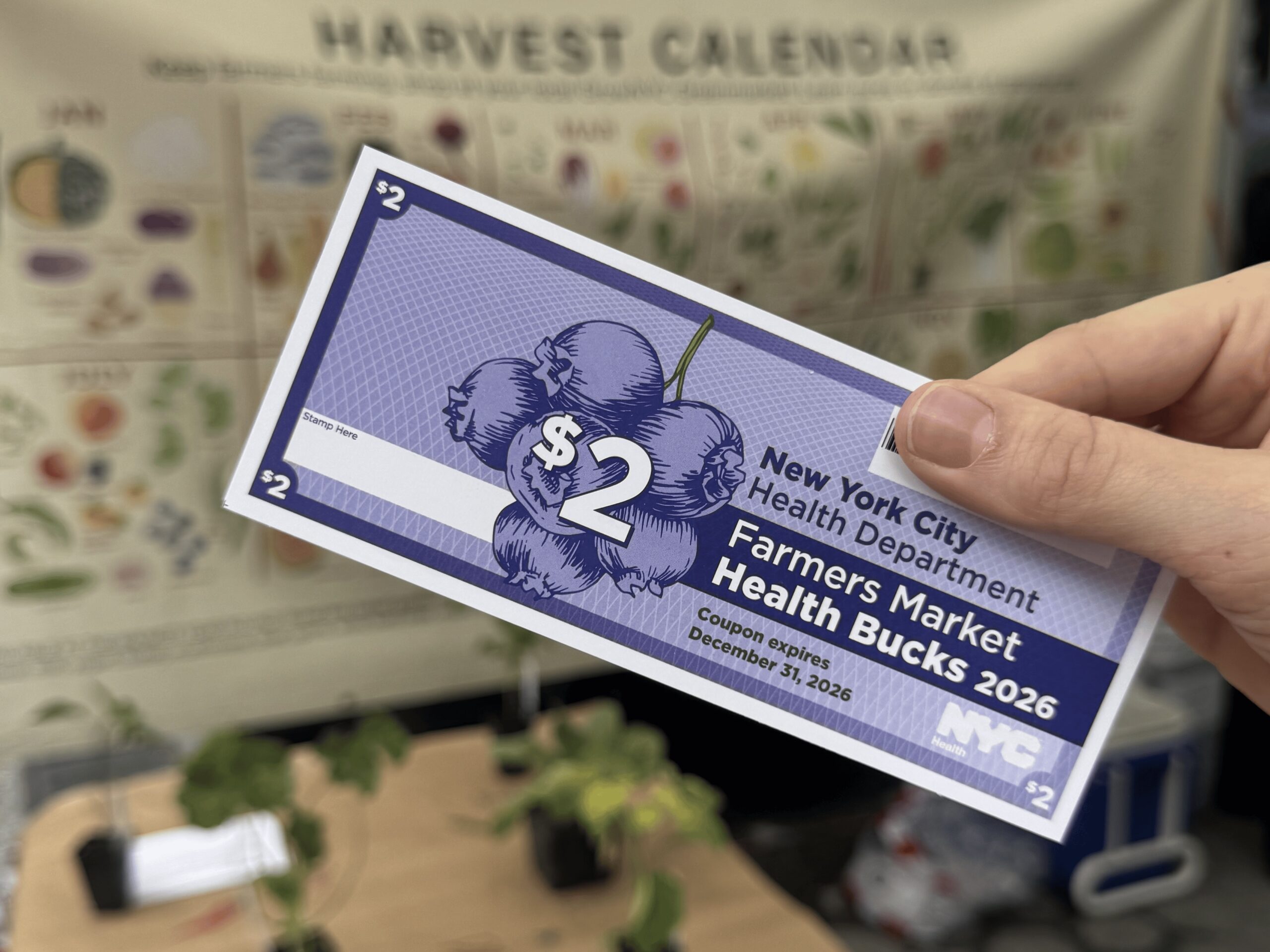
Health Bucks are $2 coupons redeemable at farmers’ markets for fresh fruits and vegetables, and they reach people in two ways. SNAP participants automatically earn $2 in Health Bucks for every $5 in SNAP spent at a market, up to $10 per day, simply by using their EBT card. Separately, several hundred community and faith-based organizations distribute Health Bucks through their own nutrition and health programming, with no SNAP enrollment required, at sites from food pantries to places of worship to school pick-up areas. This second route is particularly critical after H.R. 1 cut at least 41,000 New Yorkers off SNAP by ending eligibility for many legally present noncitizens, including refugees and asylum seekers.
The oldest of the three, Health Bucks began in 2005 in the South Bronx, distributing 3,000 coupons at 11 farmers’ markets. Today it distributes over 1 million coupons at 120 farmers’ markets through more than 500 community organizations. Redemption rates run an extraordinary 92–96% each year, and the program generated over $3.4 million in economic activity in FY2025, money that supplies New Yorkers with fresh, local food while helping farmers stay in business. Most of those markets are operated by GrowNYC, which brings local farmers and fresh produce to neighborhoods across the city.
Demand for Health Bucks has now outpaced its funding. Because each organization receives a fixed number of coupons per season, giving more to one community means less for another, and the $2 value erodes as food prices rise. More funding would support the growing number of organizations serving their communities regardless of SNAP participation, and keep drawing SNAP participants to farmers’ markets at a time when local farmers and local food infrastructure need the most support.
Get the Good Stuff
Get the Good Stuff gives SNAP participants a dollar-for-dollar match to buy fresh produce at participating grocery stores. For every dollar spent on SNAP-eligible fruits, vegetables, and beans (fresh, frozen, canned, or dried), participants earn a matching dollar toward their next eligible purchase, up to $10 per day.
Since 2019, it has grown from 6 to 25 supermarket locations across four boroughs (all but Staten Island). In FY2025, more than $2 million flowed directly to local supermarkets through the program, bolstering the economy and supporting local food businesses.
As food prices climb, the $10 daily match is no longer enough to buy several days’ worth of fruits and vegetables. Raising that amount and bringing the program to more stores would extend its reach into low-income communities, meeting New Yorkers where they already shop and giving them access to more fresh, culturally relevant foods.
What’s at Stake in the FY2027 City Budget
Together, these three programs reach New Yorkers at home, at the supermarket, and at the farmers’ market, with flexibility in how and for whom they operate. Above all, these programs are beneficial to consumers, farmers, and the local economy alike. The FY2027 City Budget will decide how far that reach extends: whether the programs grow to meet rising demand, hold flat, or, in Groceries to Go’s case, continue at all.
This budget is an opportunity to influence how public taxpayer dollars are spent: an equitable budget can and should invest in resilient food systems, address power inequities, and provide for our communities.
Mayor Mamdani’s administration is doing a phenomenal job at platforming issues New Yorkers care about, like building affordable housing, implementing a free 2-K childcare program, and supporting new small businesses. Mayor Mamdani has even announced a $70 million investment in City-owned supermarkets, with one location planned for each borough and the goal of offering lower food costs at those locations. The Groceries for All Coalition, led by our partners Community Food Advocates, commends this step as “one of the most ambitious and potentially transformative affordability interventions under consideration in New York City.”
More affordable groceries will undoubtedly be a valuable support system for residents in the neighborhoods where new stores are being planned. To complement these efforts, we hope the city will also value funding existing programs for a well-rounded food affordability platform.
This is the moment to act. Equity Advocates and the New York City Food Policy Alliance, representing 60+ food and farm groups across NYC, are urging the Administration and City Council to invest in the programs already embedded in communities and proven to work: funding Groceries to Go at $14 million and baselining it, increasing Health Bucks to at least $1 million, and maintaining Get the Good Stuff at $3.1 million. That $17.2 million would reach residents most in need across all five boroughs, and baselining it would mean New Yorkers’ access to healthy food is no longer up for debate every year the budget is negotiated.
I’m Informed. Now What?
The most direct thing you can do is call your Council Member (find them at council.nyc.gov/districts) and ask them to support these programs at the funding levels above. With the health of hundreds of thousands of New Yorkers at stake, now is the moment to make your voice heard, and for the city to expand on what it already does well.
This article represents the opinion of Equity Advocates, a New York-based nonprofit fighting food inequity through policy and systems change. The budget asks represent the opinions of the New York City Food Policy Alliance, which Equity Advocates steers. You can read their full budget platform here.