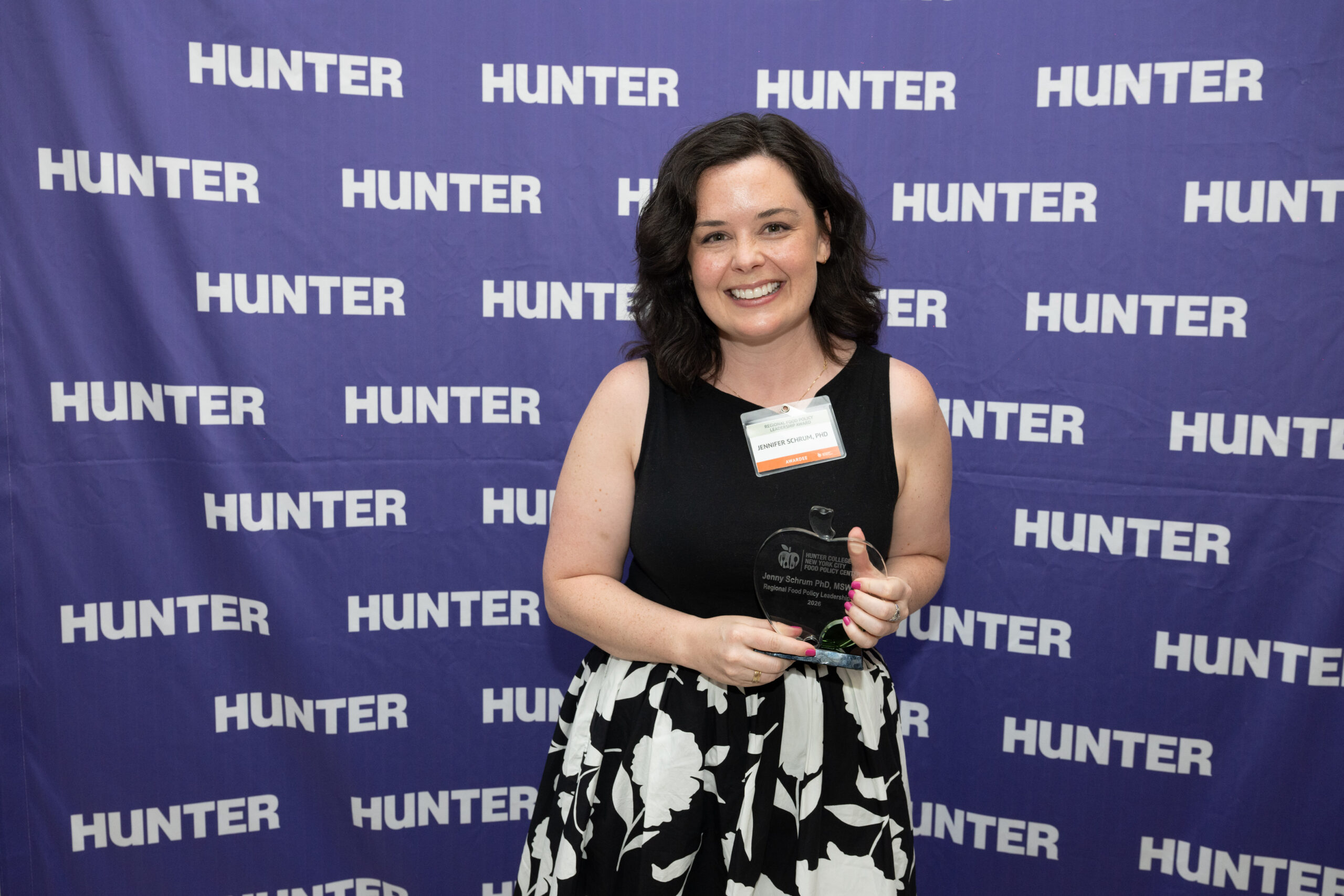
The Hunter College New York City Food Policy Center is proud to present its first ever Regional Food Policy Leadership Award, recognizing leaders who bridge research, policy, and community to advance impactful, equitable, and sustainable change across the food system in New York City and the wider region.
Our inaugural recipient is Dr. Jennifer Schrum, Director of Research and Evaluation for the New Jersey Office of the Food Security Advocate, who has helped build one of the country’s most ambitious food security measurement models. By operationalizing the six-dimensions framework, now the foundation of New Jersey’s first statewide Food Security Strategic Plan, and collaborating across the charitable food sector, public health, agriculture, and government, she has helped redefine how a state can understand and address food insecurity.
In the Q&A below, she shares her insights on food security, the six-dimensions framework, community-informed evaluation, building better data systems, and advice for others drawn to this work.
Prior to your current role at New Jersey’s Office of the Food Security Advocate, you worked across very different scales — from a single community garden at Horton’s Kids to strategy and evaluation at City Green. How has that range shaped the way you think about and approach food security today?
Working across nonprofits, academia, and government, and at different scales within those sectors, has given me a deep appreciation for both the challenges and strengths that each brings to the work. I’ve seen how community organizations can be incredibly responsive and innovative, how research can help us better understand complex issues, and how government can create the policies and partnerships needed to achieve broader impact. Those experiences have reinforced for me that food security is both deeply personal and fundamentally systemic. No single sector can solve it alone. The most effective solutions are the ones that bring together different perspectives, build on existing strengths, and stay grounded in the experiences of the people most affected.
You’ve been one of the leading champions in operationalizing the six-dimensions framework for food security. For someone unfamiliar with it, how would you explain the six dimensions, why they matter, and how New Jersey has put them into practice?
The six dimensions framework recognizes that food security is about much more than whether food is available. In New Jersey, we define food security through six interconnected dimensions: access, availability, utilization, stability, agency, and sustainability. Together, they help us better understand people’s experiences and move beyond a narrow focus on hunger alone.
What I appreciate most about the framework is that it encourages us to ask bigger questions. Do people have choices that align with their culture and preferences? Are they able to consistently access food over time? Are our food systems supporting communities and the environment for the future?
In New Jersey, we’ve embedded the six dimensions throughout our Food Security Strategic Plan and use them to guide research, funding opportunities, and partnerships. The framework has helped create a shared language across sectors and has encouraged organizations to recognize that many different types of work contribute to food security. Ultimately, it has allowed us to take a more holistic and strengths-based approach to improving well-being across the state.
You’ve talked about your passion for strengths-based and community-informed evaluation. What does that approach look like in practice, and how does it differ from how evaluation in this field is typically done?
For me, strengths-based and community-informed evaluation starts with the belief that communities are experts in their own experiences. Rather than focusing only on deficits or asking, “What’s wrong?”, I try to ask, “What’s working, and how can we build on it?”
In practice, that means engaging community members and partners throughout the evaluation process, incorporating both quantitative and qualitative data, and using findings to support learning and improvement rather than simply judging success or failure. I believe communities should help define what success looks like, and that evaluation questions should be purposeful and answer things that are meaningful to the people most affected by the work.
Historically, evaluation has often been done on people rather than with communities. I believe evaluation is most valuable when it helps elevate lived experience, recognize existing assets, and generate knowledge that communities themselves can use.
With the USDA ending its annual food security report, many states are now without a way to track hunger at all. What advice would you give to researchers and advocates trying to build better data systems in their own states?
My advice would be to start with the understanding that data are only useful if they help inform action. States do not necessarily need to recreate a large national survey, but they do need a thoughtful approach that combines multiple sources of information and includes the voices of communities themselves.
I would also encourage people to take stock of the data that already exist. The loss of the USDA’s annual food security report is significant, but it is not the only source of food security-related information in the United States. There are many existing administrative datasets, health surveys, and community-level sources that can help paint a more complete picture when used together.
I also think this is an opportunity to rethink who data systems are designed for. Communities should help shape the questions we ask and how we define success. When data are timely, meaningful, and connected to people’s lived experiences, they become much more powerful tools for advocacy and systems change.
For students or early-career researchers and advocates drawn to this work, what’s the most important skill, mindset, or habit to develop early on — and what’s something you wish someone had told you when you were starting out?
I think one of the most important things to develop early on is curiosity and a willingness to listen. Food security is a complex issue, and no one discipline or sector has all the answers. Some of the most valuable lessons in my career have come from community members, practitioners, and colleagues with very different perspectives from my own.
I would also encourage people not to put themselves in a predefined box. There is no single path into food security work, and there is no one type of food security researcher. This field needs people with backgrounds in public health, social work, agriculture, policy, economics, community organizing, data science, and many other areas. My own career has moved across nonprofit organizations, academia, and government, and each experience has shaped how I approach the work today.
Something I wish someone had told me earlier is that your career does not need to be linear. Following your interests, building relationships, and staying open to unexpected opportunities can lead you to places you never anticipated. Some of the most meaningful opportunities in my career were ones I could not have planned for when I was first starting out.
Fireside questions:
Pronouns: She/her
Grew up in: New Brunswick, NJ
One word you would use to describe our current food system? Dynamic
What’s a food system problem you wish more people were talking about? I wish more people were talking about agency. Food security is not just about having enough food. It’s also about having choice, dignity, and the ability to access foods that align with your culture, preferences, and values. Agency also means having a voice in the policies and decisions that affect your community. Those aspects of food security are incredibly important, but they are often overlooked in the conversation.
Your breakfast this morning: Oatmeal, don’t underestimate its power!
Favorite NYC food spot and why? Honestly, not one, but I love a neighborhood food tour paired with some architectural and pop culture history. Exploring different communities through food is one of my favorite ways to experience New York because it reminds me that food is deeply connected to culture, history, and place.
Must-read or must-listen: Reinventing Food Banks and Pantries by Katie Martin. It offers a thoughtful vision for how charitable food systems can better center dignity, choice, and community.
Social media must-follow: @citygreennj for behind the scenes on community gardening, urban ag, pollinators, food access, and more! You can really see these programs through the eyes of the people in them.
What, if anything, is giving you hope right now? The diversity of thought across the food system space. Food touches every person and every community, which means there are countless perspectives, priorities, and ideas being brought to the table. I find hope in the creativity and collaboration that emerge when people from different sectors and lived experiences come together to solve complex challenges.