When New York City’s emergency food network expanded rapidly during the COVID-19 pandemic, much of the public’s attention was focused on volume—how many millions of meals were distributed, how long pantry lines had grown, how much federal funding had flowed through the Human Resources Administration’s Community Food Connection (CFC) program (formerly known as the Emergency Food Assistance Program (EFAP)). Less obvious but arguably more consequential for long-term food access was a quieter shift inside the pantries themselves: intake forms grew longer, client databases became more sophisticated, and digital appointment systems began to regulate access to groceries. Despite its scale, however, there is still no universal standard governing intake procedures.
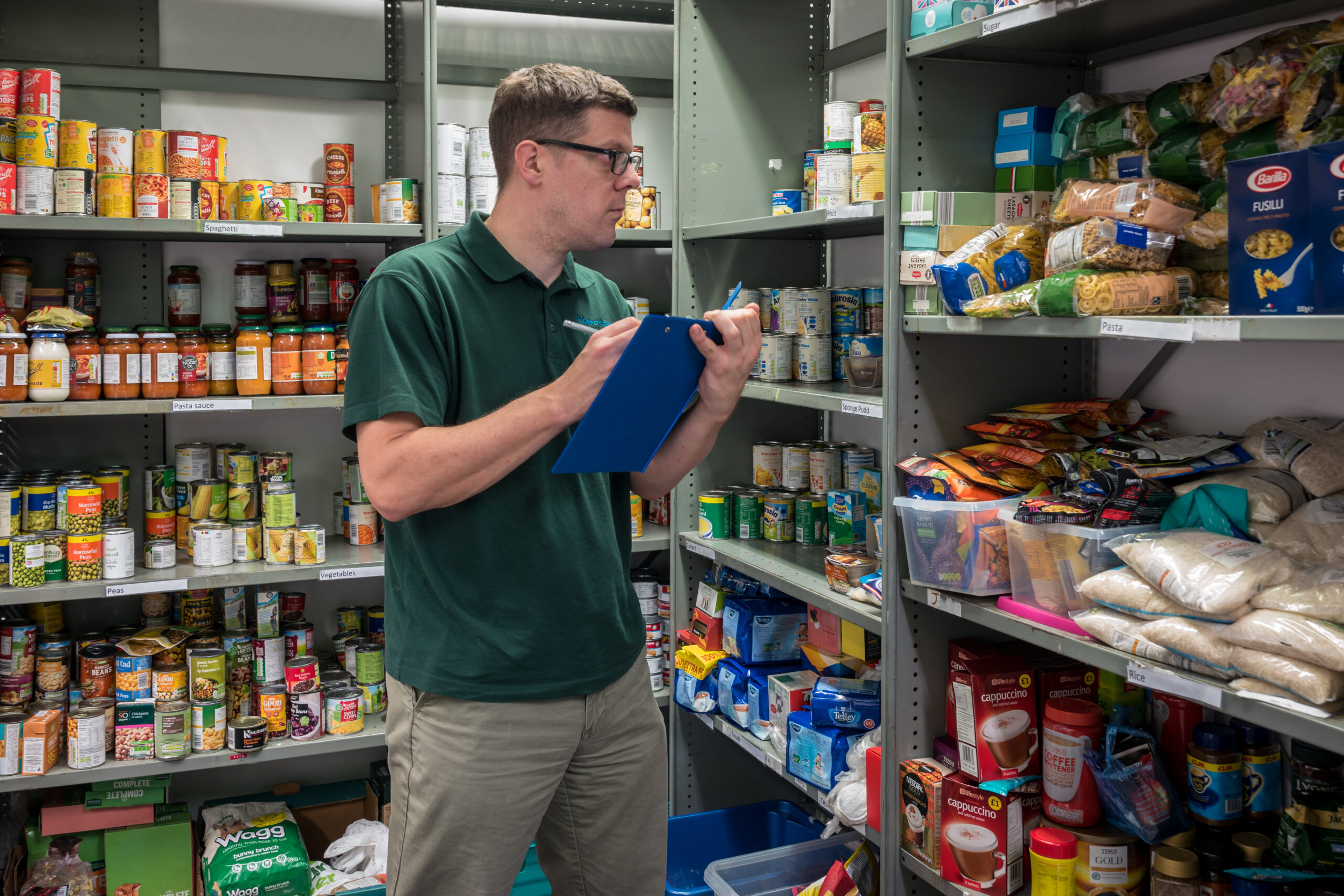
Five years later, those reformatted administrative processes have come to redefine the way New Yorkers obtain emergency food. Through the CFC program, the city now funds more than 700 pantries and community kitchens. Some pantries require government-issued identification and proof of address. Others ask only for a name and household size. Some rely on apps that require smartphone access and digital literacy. Others continue operating on walk-in models.
Supporters of more formalized intake argue that these systems improve efficiency, reduce duplication—instances in which the same household collects food multiple times in a single distribution cycle, depleting limited supplies and skewing the counts pantries report—and help organizations secure funding by documenting whom they serve. Critics counter that the same systems are quietly reshaping the emergency food sector into something more bureaucratic and less accessible, particularly for undocumented immigrants, newly arrived asylum seekers, unhoused New Yorkers, and people living in poverty, a 2024 study in Food Security found that ID and proof-of-residency requirements deter precisely these groups, since undocumented clients fear being reported and people without stable housing often cannot supply a fixed address.
Greg Silverman, CEO of the West Side Campaign Against Hunger, one of the city’s largest emergency food providers, argues that the deeper problem is structural, not procedural. “The system is too fragmented,” he said. “No one should have to travel across the city to eat. People should be able to get healthy, culturally appropriate food they need, for themselves and their families, where they already are. Scrappy volunteerism is admirable, and we at WSCAH work with thousands of amazing volunteers each year, but it’s not the main way you feed a city of eight million people.”
At WSCAH, he added, tracking customers is a way to connect them to other benefits, not to police them. “The question isn’t whether people are tracked, it’s whether they have access to healthy, culturally appropriate foods in a dignified manner,” he said. “Better data would help. But the real measure is whether people get the food they want and need.”
How Pantries Became More Like Public Benefit Programs
The growing formalization of pantry operations did not emerge in a vacuum. During the pandemic, food insecurity surged dramatically, overwhelming many organizations; emergency food visits across the city rose more than 80 percent between 2019 and 2024. Pantries that once served a few hundred families weekly faced lines that stretched down blocks and around corners. At the same time, philanthropic funders and government agencies increasingly demanded measurable outcomes and detailed reporting. City-funded providers, for instance, must document the number of individuals and visits they serve to maintain support. Data collection became central to grant compliance and operational planning.
Organizations also adopted technology to streamline operations. In New York City, the most prominent example is Plentiful, a free reservation app built by the New York City Food Assistance Collaborative—a coalition that included City Harvest, United Way of New York City, and the Mayor’s Office of Food Policy—and now used at hundreds of pantries across the five boroughs. Online scheduling platforms and digital client databases like it can reduce wait times, improve inventory management, and prevent duplicate pickups. The app’s developers cite field studies finding that a reservation saves clients more than an hour of waiting per visit, and its messaging works in nine languages, easing communication in immigrant neighborhoods.
From an administrative perspective, these systems make sense. Food providers operating on limited budgets need reliable data to justify funding and allocate resources efficiently. But the same tools illustrate the tension at the heart of this shift: Plentiful collects limited client information, including name, age, ZIP code, and check-in times, that feeds real-time dashboards used by food banks and funders. For clients with a smartphone, the trade-off is dignity and a shorter wait; for those without one, or without the digital fluency to navigate an app, it can become one more barrier between them and a bag of groceries.
In practice, many immigrants remain wary of providing identifying information, particularly amid heightened federal immigration enforcement and ongoing confusion around “public charge,” the immigration test that can deny a green card or visa to someone deemed likely to become primarily dependent on government assistance. Public charge is an immigration determination, not a benefits rule, and it has never counted the use of food pantries, SNAP, or other nutrition programs. But a proposed federal rule published in November 2025 that would broaden which benefits count, combined with the sheer breadth of the surrounding rhetoric, has deepened fear even among families to whom the test does not apply.
That fear intensified in the summer of 2025, when four federal agencies abruptly reinterpreted the Personal Responsibility and Work Opportunity Reconciliation Act (PRWORA)—the 1996 welfare law—to expand the list of programs that could be treated as “federal public benefits” requiring immigration-status verification. For nearly three decades, administrations of both parties had read the law to let states offer health, education, and anti-poverty services regardless of status; the new directives swept in programs the government had long exempted, among them Head Start, community health centers, and food banks that receive federal support. On September 10, 2025, a federal court granted Attorney General Letitia James and a coalition of 20 other attorneys general a preliminary injunction blocking the new rules in New York and the other plaintiff states while litigation proceeds. Still, advocates say the policy discussion itself deepened anxiety among immigrant-serving organizations.
That anxiety produces a familiar chilling effect. A fear of leaving a paper trail can keep eligible families away from services no rule actually bars them from using.
Exclusion by Friction
Exclusion does not always happen through explicit denial. More often, it happens through “friction,” meaning that, even though an individual may be eligible for aid, the process required to access the service is so difficult to navigate that the applicant simply gives up.
A person without stable housing may not possess current identification or proof of residency. Someone fleeing domestic violence may avoid systems that require documentation tied to a previous address. Newly arrived migrants may struggle to navigate English-language intake forms or app-based scheduling systems. Older adults and digitally disconnected residents may have difficulty securing pantry appointments online. Even small procedural barriers can deter people already living under significant stress.
Research has consistently shown that complex eligibility systems disproportionately exclude vulnerable populations. Public-policy scholars Pamela Herd and Donald Moynihan describe these obstacles as “administrative burden,” the learning, compliance, and psychological costs people absorb when navigating public assistance. Emergency food systems, historically designed to minimize these barriers, are increasingly adopting the same bureaucratic logic that underpins formal welfare programs.
This shift reflects broader changes in the charitable food sector nationally. Food pantries increasingly resemble professional service organizations rather than informal emergency responders. Many now operate supermarket-style, customer-choice models—pioneered in New York by the West Side Campaign Against Hunger—with inventory software, appointment-management platforms, and detailed client metrics. While these innovations can improve dignity and efficiency for some clients, they may unintentionally disadvantage others.
A Fragmented System in a High-Demand Moment
The contradiction is particularly stark in New York City, where food insecurity remains persistently high despite the city’s extensive anti-hunger infrastructure. An estimated 1.4 million New Yorkers, including one in four children, are food insecure today, up from roughly 1.2 million in the years before the pandemic. Rising rents, persistent food inflation, and the expiration of pandemic-era benefit expansions have pushed demand well past its COVID-19 peak: City Harvest reports that visits to its partner pantries climbed from roughly 25 million in 2019 to more than 46 million last year.
Many pantry users are employed but still unable to afford necessities. Community organizations report that food pantries are no longer serving only people in acute crisis; they have become part of many households’ long-term survival strategies.
At the same time, pantry providers themselves are under enormous pressure. Food costs have risen. Donations fluctuate. Federal nutrition programs face periodic political uncertainty. Many organizations are attempting to serve unprecedented numbers of people while satisfying funder reporting requirements and preventing accusations of fraud. In this context, documentation and tracking systems are often framed as necessary tools for accountability rather than as exclusionary measures.
Some providers have tried to strike a middle ground by explicitly adopting low-barrier intake policies. Others intentionally avoid collecting immigration-related information altogether. But because pantry rules vary widely from one to another, access can become inconsistent and confusing. One pantry may ask for extensive paperwork while another nearby requires none at all. The result is that the burden of navigating the system falls largely on the hungry people themselves.
Two Models, One Question
There is also a larger philosophical question embedded in these debates: should emergency food assistance function like a public benefit program or like unconditional humanitarian aid? Public benefits typically require verification and oversight. Emergency food has historically operated more on trust.
As hunger increasingly becomes chronic rather than episodic in New York City, policymakers and providers appear caught between these two models. Some argue that the city should establish clearer standards limiting documentation requirements at publicly supported pantries. In contrast, others recommend expanding anonymous or low-threshold distribution models, particularly for immigrant communities and unhoused residents.
Some anti-hunger advocates have also argued that funding decisions should weigh not only how many people a pantry serves, but also how accessible those services are. Silverman, testifying before the City Council in March 2025, framed dignity itself as a question of access, arguing that real “choice” extends beyond which foods a client picks to “the location of service, the delivery models and how you spend your time” getting food. Proposed accessibility measures include whether pantries allow walk-ins, provide multilingual services, avoid mandatory ID requirements, offer alternatives to online scheduling, and accommodate people without permanent addresses.
If the emergency food system becomes too administratively burdensome, some of its most vulnerable users may quietly disappear from the data entirely, and hunger that goes uncounted is often hunger that goes ignored.