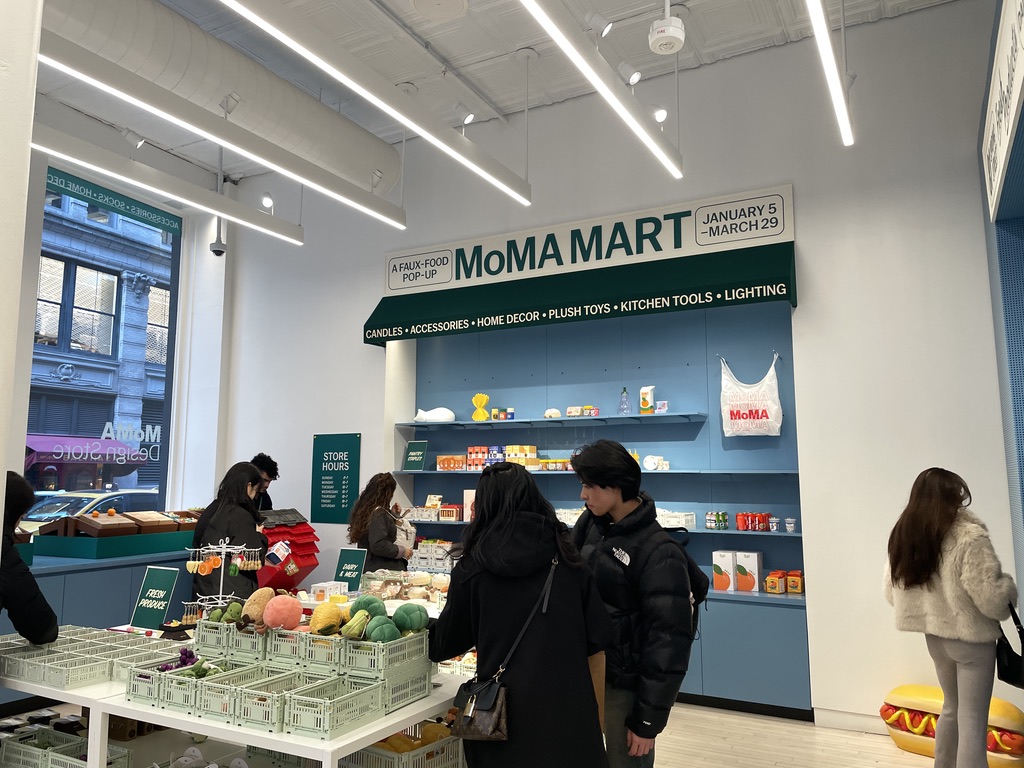
Photo: The SoHo MoMA Mart location on 81 Spring Street.
Front and center at The Museum of Modern Art’s Design Stores this winter is MoMA Mart, a tromp-l’œil mini-market stocked entirely with collectibles, clothing, and lifestyle objects. I visited the SoHo installation on a sunny weekday afternoon with plenty of shoppers were eager to handle the cans, fruits, and packaged goods on display. There was a sign with the pop-up’s hours as well as signs for different categories of food, such as “pantry staples” and “dairy & meat.” I sniffed candle apricots and strawberries, hoping for some lifelikeness. They smelled only of beeswax. The Midtown location was similar, with the addition of a mural of a bakery by Julien Ceccaldi at the Museum’s Modern Window site across the street. Everything was designed in the name of “fun” and “function,” and it was charming, but in the way that only something detached from necessity can be.
I also happened to visit at a time when one in five New Yorkers depend on SNAP benefits and when the federal government has gutted food assistance programs and stopped measuring hunger altogether. With this in mind, when I asked an employee at the downtown store about how the fake grocery store was doing, they said something that both concerned and confused me: “It’s the most successful pop-up section we’ve ever had, in my opinion.”
Both stores’ shelves looked emptier than the social media posts and articles from Forbes and Time Out had advertised. What remained made two things clear: America really does have an obsession with fake food, from ultra-processed ingredients and TV competition game shows like Is It Cake? And MoMA Mart is doing exactly what it was designed to do: catering to patrons who can afford to drop a few hundred dollars on corn cob stools instead of real, edible groceries, at a moment when millions of their neighbors are struggling to do exactly that.
The irony is that MoMa helped build its reputation on artists who wanted their audiences to see consumption as a widespread societal problem. Think Andy Warhol’s 1962 Campbell’s Soup Cans, Yayoi Kusama’s pumpkin motif, or surrealist Meret Oppenheim’s 1936 Object. These weren’t a celebration of the supermarket aisle, but a reflection of modernity’s overwhelming mass consumerism. When artists assume the role of chef (and vice versa) to use food as a medium of artistic expression today, it still causes quite a ruckus. Consider, for example, Kara Walker’s controversial 2014 A Subtlety or A Marvelous Sugar Baby or this dessert from Grant Achatz’s Alinea in Chicago that required diners to use their hands to eat the dish from their tablecloth.
Many modern artists were fixated with food (and likewise food policy) because it has a direct correlation with the word “consumption”—to “consume” meaning both “eat” and “purchase.” In a post-war America, the middle and upper classes were buying more objects, services, and food than ever because the concept of a modern world was a bountiful world. The United States government helped with that ideal, too, when it subsidized meat, dairy, corn, soy and ultra-processed foods. Artists who mass-produced prints and sculptures of mass-produced food were expressing their disapproval of an ever-hungry culture traumatized by six years of lack and destruction during World War II. Yet, it seems that MoMA’s pop-up now leans into, rather than judges, consumerism.
The MoMA Mart, from what I can see online, has not caused much controversy. Most of the online magazines have positioned the installation as quirky. But timing matters. At a moment when food access is under unprecedented political attack, and manipulating access to food has become one of the Trump administration’s favorite weapons, MoMA’s fake grocery store reads as indifferent at best and at worst a callous spectacle of consumption for those who have the luxury of treating food as an aesthetic rather than a necessity.
The federal government has spent the past year making food access more difficult and hiding the evidence. The government shutdown halted SNAP benefits for 1.8 million New Yorkers, approximately one in five city residents. New work requirements and tightened eligibility requirements as a result of the “One Big Beautiful Bill Act” (H.R. 1), signed by President Trump on July 4th, 2025, threaten to cut SNAP benefits for 22 million families nationwide—including more than 300,000 households in New York alone. Meanwhile, the USDA quietly announced it would stop conducting its annual food insecurity survey, eliminating the primary tool we use to measure how many Americans cannot afford to eat. The official justification was “redundancy.” The practical effect is that we’ll have less reliable data on hunger during this administration. More recently, when Minnesota pushed back against disputed fraud allegations from its Somali communities, the administration threatened to withhold $129 million in food aid, using hunger as extortion.
The timing gets worse. The installation debuted the same week as when RFK Jr. and the Trump Administration announced its “reset” of the United States’ dietary guidelines. The new guidelines have since received a substantial amount of criticism, with some calling the guidelines imbued with “politically driven deviations” from accredited health and medicine institutions, such as a lack of transparency regarding methodology or who actually wrote the guidelines. The Dietary Guidelines Committee itself is composed of members with plenty of conflicts of interest, such as former Nestlé consultants and leaders of the American meat and dairy industries. While the Trump administration is determined to end the “war on protein” and has made it even more challenging to access real food, MoMA wants us to gawk over plush avocados.
My contention with the MoMA Mart pop-up isn’t just about SNAP recipients. Food in New York City is expensive for most residents. Food costs have risen more than twenty-five percent in the past few years. Some pantries reported their patrons’ demands had exceeded supply during the 43-day government shutdown in 2025. Within the last two years, more than one third of New Yorkers reported needing more money for food. This issue is part of the reason Mayor Zohran Mamdani’s 2025 campaign was so successful. His idea for establishing subsidized grocery stores was aimed at battling price gouging and inflation.
This romanticization made MoMA Mart feel a bit dystopian, if not a particularly cruel and flashy form of mockery. The Store’s target audience is mostly customers who have enough money to spend on superfluous and “elevated” lifestyle objects. There is something uncannily (or unfortunately) similar to the bureaucratic élites in The Hunger Games vomiting to consume more food while the outer “districts” barely had anything to eat. And in our world, buying expensive artificial food is a let-them-eat-cake demonstration of excess and choice when so many don’t have the money to buy the real thing. However, I don’t see insensitivity as the only concern with this installation.
When I took a closer look at the display in the SoHo MoMA Mart, much of the plush and felt “produce” seemed familiar. It wasn’t just the Jellycats, a collectable stuffed toy that has gained popularity with Gen Z, and their distinctive pair of eyes and wide smiles. In the context of a tromp-l’œuil supermarket, the arrangement looked remarkably like the work of British artist Lucy Sparrow, who has spent years sewing felt replicas of grocery items and staging supermarket pop-ups around the world. Sparrow’s 2017 8 ‘till Late installation in Manhattan’s Meatpacking District featured a fully functional “24-hour shop” or bodega stocked with thousands of plush replicas of food, cleaning supplies, NYC staples, and even a plush cat. MoMA Mart felt tactless in the shadow of a more rigorous installation. But whatever the differences in scale and intent, Sparrow’s exhibition and MoMA Mart share something uncomfortable: they sensationalize New York working class retail culture for audiences who don’t necessarily depend on it.
That dynamic has a specific racial and cultural dimension worth naming. Bodegas aren’t just small stores, they are neighborhood institutions built and sustained largely by people of color and immigrant communities. Let’s not forget the word “bodega” means “storeroom” in Spanish and was popularized by Puerto Rican business owners, as Hunter College’s CENTRO contextualized in their 2025 “Jonny Torres Papers” event. So to intellectualize bodega culture, whether you are an independent artist or an art museum, because the people of color who are its nexus are not cultured nor highbrow enough for you, is a kind of extraction.
What’s frustrating is that MoMa knows better. MoMA PS1, MoMA’s contemporary art space in Long Island City, exhibited Jumana Manna’s 2022 Break, Take, Erase, Tally, an exhibition about the erasure of Palestinian culture through food that engaged intimately with indigenous agriculture, colonialism, and loss. That show asked hard questions. I’m not entirely sure which questions MoMA Mart wants us to consider. The least the store can do is be more attuned to the world around it.
MoMA’s press team told me the installation was meant to be “on the fun and playful side of things,” which didn’t differ much from the pop-up’s description online. I believe them, though. And that’s precisely the problem. Now might not be the time to play with our food and this was a missed opportunity for one of the world’s leading cultural institutions to engage critically with food systems. While the intent of a grocery store is to make a profit, its function is to prevent food insecurity, so it is impossible to separate hunger and consumption from any representation of a minimart.
I think MoMA Mart’s intentions are even more simple than wanting to be “fun and playful.” The employee at MoMA’s SoHo Design Store told me the pop-up was the store’s most popular not because of the concept—a faux grocery store—but because of the Jellycats. “You would not believe how people are going crazy for the Jellycats. The amount of people that would come in here and be like, ‘You got Jellycats?’” The installation could have just been an elaborate method to sell a very trendy collectible at a museum markup.
Although, I would assume it was not on the Design Store’s agenda to taunt the growing number of hungry New Yorkers, it still surprises me that the consultancy group the MoMA Design Store team works with would not provide some insight or research into the current state of food access in the City. I think MoMA could have avoided this issue had they reached out to an organization—not necessarily the Food Policy Center, but any of those working with food justice—to get a better read of the room. It is not about whether a MoMA Mart can or should exist, but whether its installation should have continued given the current reality for tens of millions of people in America.
Even if the MoMA Design Store had been fully aware of the current state of food insecurity and chose to move forward anyway, there were obvious ways to engage responsibly: an educational component, a partnership with a food justice organization, even a portion of proceeds directed towards food access. None of that appears to have happened. This raises a question about MoMA’s institutional structure: how much does the Design Store actually coordinate with the museum’s curatorial and programming side, which has shown it can engage thoughtfully with food politics? Or does the MoMA branding simply flow one way—lending the museum’s cultural authority to a retail operation that functions independently of its values?
Modern artists made art about food to make us uneasy. MoMA made a store about consumption to make a sale. And by the SoHo store employee’s own account, it worked. Despite rising food costs, despite SNAP cuts, despite pantries running dry across the city, conspicuous consumption continues. Whatever MoMA Mart tells us about design, what it reveals about appetite is less flattering.
MoMA Mart is up until March 29, 2026. You can find it at the MoMA Design Store at 81 Spring St., 44 West 53rd Street, New York, NY or on their online store.