The Mayor’s Office of Urban Agriculture (MOUA) isn’t a household name. Given what it’s quietly accomplished since it was established in 2022, with limited city funding and just two full-time staff, it probably should be.
For decades, urban agriculture operated on the margins of policy attention and public investment, treated as nice-to-have rather than a serious tool for change. That shifted in 2021, when the City Council passed Local Law 121 and Local Law 123, formally recognizing that urban agriculture deserved a permanent home in government. The legislation created MOUA, housed within the Mayor’s Office of Climate and Environmental Justice, and tasked it with producing a comprehensive urban agriculture report, building an online portal with mapping tools, running education and outreach programs, conducting research to inform future legislation, and advising other city agencies on how to protect and expand urban agriculture. The laws also authorized an independent Urban Agriculture Advisory Board to bring together advocates, academics, and agriculture experts. The former mayoral administration never appointed the board, but MOUA moved forward without it.
Three years in, the office is delivering on its full mandate. It built its own relationships with community leaders and advocates, launched education programs connecting students to working farms, opened pathways for small farmers to sell to city institutions, mapped the city’s urban agriculture landscape, and pushed for procurement reform that could redirect how the city spends its food dollars. The office is working to change how eight million New Yorkers grow, buy, and think about food, using urban agriculture as a lever for climate action, environmental justice, food access, workforce development, and economic resilience.
NYC’s Urban Agriculture Landscape
To understand what MOUA is building, it helps to first understand the landscape it’s tasked with overseeing, growing, and making accessible to more New Yorkers.
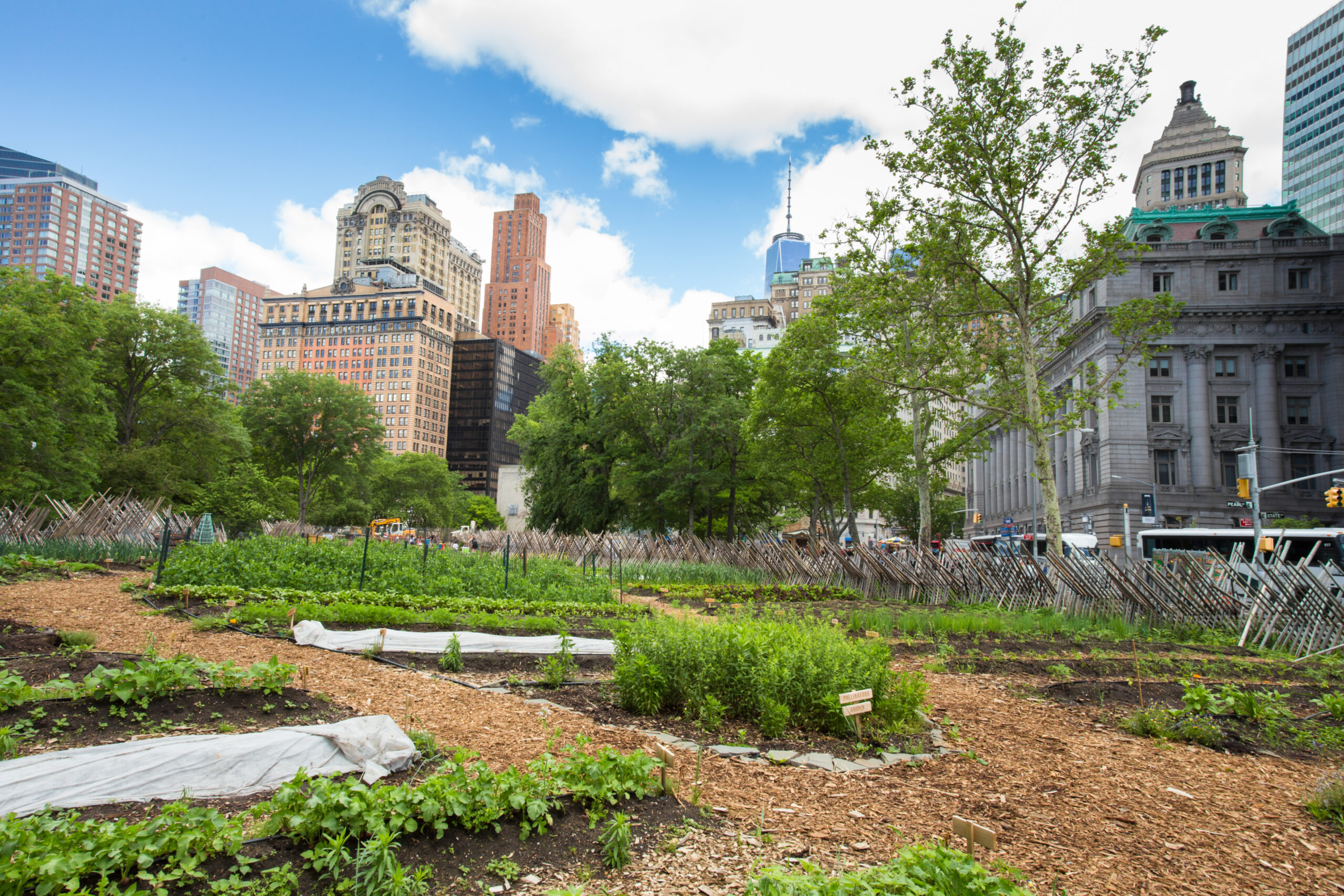
Urban agriculture in New York takes many forms: community gardens where neighbors grow vegetables and flowers, urban farms selling produce at farmers markets or donating to food pantries, school gardens, rooftop farms, controlled environment agriculture (CEA), food forests, and backyard plots. Some sites trace their roots to the 1970s, when communities started reclaiming vacant lots during the city’s fiscal crisis. Others have emerged more recently as interest in local food systems has grown. The land stewards who tend to these spaces range from professional farmers to weekend hobbyists tending personal plots to volunteers who show up at community workdays to weed beds they’ll never harvest from.
The food these sites produce serves many purposes. For some growers, it’s a livelihood; for others, supplemental income. It can help food-insecure families stretch their grocery budgets and supply fresh produce to food pantries and community fridges. And for many immigrant communities, it offers a chance to cultivate crops with cultural significance that aren’t available in local stores and to pass down agricultural knowledge across generations. The benefits also extend beyond the harvest. Gardens and farms absorb stormwater, cool neighborhoods, support pollinators, and provide green space in neighborhoods where it’s scarce. Research has linked community gardening to better mental health, more physical activity, and stronger neighborhood ties.
But this valuable and vast network has grown in varied ways over time. While the majority of community gardens in the city are under the NYC Parks jurisdiction, there are also gardens and urban farms at NYCHA housing developments, school grounds, and privately held lots. Most gardens in the city are under license agreements from the city, while some are managed through informal agreements. Until recently, no one in city government even had comprehensive data on what existed or where.
The First Comprehensive Map
One of MOUA’s first priorities was building a complete picture of urban agriculture across the city, and making that information available to the public. The office created the Urban Agriculture Data Explorer Hub, an interactive platform that maps food production across all five boroughs. The tool has cataloged 2,580 sites so far: school gardens, urban farms, community gardens, indoor agriculture businesses, and underutilized city-owned land. Users can sort by borough, zip code, land management type, and food production status, then click on individual locations for more detail. The platform will eventually also track wellness programs, commercial activity, and climate mitigation efforts. Its crowdsourced design allows community members to contribute information that official records miss, creating a more complete picture over time.
Having this data in one hub serves multiple purposes: raising public awareness of what exists, connecting residents to programming in their neighborhoods, and informing the city’s policy decisions about urban agriculture. In January 2025, MOUA hosted its first citywide data convening, gathering stakeholders to engage with the platform and guide how the city collects, applies, and reports this information going forward. MOUA plans to include additional datasets, visualizations, and other metrics in future updates on the Data Explorer Hub.
Reimagining Farm to School in NYC
Cataloging the city’s urban agriculture was a necessary step, and MOUA is also working to grow it, starting with the youngest New Yorkers. For many students, food is something that arrives on a cafeteria tray, with no connection to the soil, seasons, or the hands that grew it. The Reimagining Farm to School in NYC program is MOUA’s effort to bridge that disconnect.
Over the past two years, the program has brought hundreds of students from sixteen schools to urban farms across the boroughs–from New Roots Community Farm in the Bronx to Green Valley Community Farm in Brooklyn to Gracie Mansion–where urban farmers teach them about culturally relevant crops, growing cycles, and how food travels from ground to table. Community chefs, through a partnership with Just Food, prepare seasonal dishes with locally grown produce. Students share recipes from home. Several schools have received grants to build or upgrade gardens.
The impact is visible in the classroom. Alison Coviello, principal at P.S. 154/Jonathan Hyatt, says her students “thrive when they get to plant, harvest, and taste,” describing their excitement about the program as “palpable.” For the students themselves, the appeal is hands-on and immediate. “It was excellent, I was a sous chef!” one P.S. 721X student recalled of a cooking session. “I helped prepare a delicious salad dressing. It was cool to look, touch, and taste all of the plants.”
The office plans to scale up this program significantly. MOUA aims to expand to sixty schools over the next two years, build or revitalize up to ten school gardens, and develop a new curriculum alongside gardeners and educators.
Beyond the classroom, MOUA is exploring other ways to bring food production onto school grounds. At Adlai Stevenson High School in the Bronx, the office is helping revitalize a long-fallow orchard into a working food forest that will grow vegetables, fruit, mushrooms, and herbs for students and neighborhood residents. With support from City Council Majority Leader Amanda Farías and the local community, teachers and students will help shape an integrated curriculum for the outdoor classroom. A request for information has been issued on developing food forests at additional sites.
A Million Meals a Day, Few From Nearby
Programs like Reimagining Farm to School in NYC are building a new generation’s relationship with local food, but education alone won’t grow the urban agriculture network. For that, micro to mid-sized producers need market access. And in New York, one of the biggest potential markets has long been closed off to them.
New York’s public schools serve nearly a million meals a day, making the system one of the largest food purchasers in the country. That buying power could be transformative for micro to mid-sized producers. But the procurement system rewards scale: certifications, insurance requirements, and paperwork that large distributors navigate routinely can shut out smaller operations. Farmers from historically marginalized communities face additional barriers, often lacking the resources or institutional knowledge to compete.
MOUA is working to change that. NYC School Food EATS (Enhancing Accessibility, Training, & Support), the city’s first program of its kind, gives farmers and food hub operators step-by-step guidance on selling their products to public schools. Developed with Cornell Harvest NY and funded by a state Farm-to-School grant, the program also helps participants obtain Minority and Women-owned Business Enterprise certification, a credential that can open doors to contracts across city government.
Nine farm and food hub businesses completed the inaugural cohort. The scale of full DOE contracts remains a hurdle for most, but MOUA is finding other ways to connect these growers with institutional buyers–creating multiple seasonal micro-purchasing opportunities that have brought fresh, culturally relevant produce from cohort farms to students and elders citywide. The office is now working to scale up the program and open more procurement pathways for small producers.
But training programs can only do so much. They help farmers compete within a system that wasn’t built for small producers in the first place. Changing the system itself requires policy reform, and that has proven harder.
In 2017, New York City enrolled in the national Good Food Purchasing Program, a framework designed to align food spending with values like sustainability, nutrition, and local sourcing. The initiative has grown to include multiple city agencies, but state law limits how far the initiative can go. Under New York’s General Municipal Law, municipalities have historically been required to award contracts to the lowest bidder. A 2012 amendment allowed agencies to consider “best value” instead, but the law defines that term narrowly: quality, cost, and efficiency. Local sourcing, environmental impact, and public health are not among the criteria agencies can use to justify choosing one bid over another.
In 2024, the New York State legislature passed the Good Food NY bill, which would have allowed municipalities to prioritize local sourcing, sustainability, worker rights, and nutrition in awarding contracts, even if a bid came in up to ten percent higher than the cheapest option. Governor Hochul vetoed it.
That veto hasn’t stopped MOUA from pursuing change through other channels. At the federal level, the office worked with elected officials to develop the Growing Opportunities in Innovative Farming Act, the city’s first urban agriculture marker bill, which was introduced in both houses of Congress. With the Farm Bill up for reauthorization, the bill makes the case for expanding federal support for urban agriculture, both in New York and across the country.
Closer to home, the office launched Purchasing with Purpose, a community information series that brings together policy experts as well as farmers, gardeners, micro to mid-sized food businesses, and advocates, groups that rarely have a seat at the table when procurement rules are being written. The goal is to surface barriers and shape what equitable, values-driven purchasing could actually look like. The series has featured national leaders including the Center for Good Food Purchasing and the Chicago Food Policy Action Council, and will continue into 2026.
Meet the Executive Director
The guiding force behind all this work is Executive Director Qiana Mickie, who has led the office since its founding in 2022. She came to city government with more than a decade of food systems advocacy behind her. Before joining city hall, she ran Just Food, where she pushed for equitable food and farm policy while training community leaders to launch CSA programs, farmers markets, and community chef initiatives. She has worked on food sovereignty, land stewardship, and health policy at every level, from neighborhood organizing to international forums, and she brings that expansive perspective to everything the office does.
“From the moment we established this office, equity has been our North Star,” Mickie said. “Too often communities feel shut out of city government and don’t believe that it is working for them. Urban agriculture empowers communities.”
That belief shapes everything MOUA does. Under her leadership, the office has made equity central to its mission and embedded community engagement into its work.
“At MOUA, we have taken a community-first approach in establishing agriculture and food sovereignty infrastructure projects across the city,” Mickie said. “We view agriculture infrastructure as critical for our city, requiring strong attention and investment if we are ever to realize a truly holistically integrated city that works for all New Yorkers.”
The office has also built partnerships that extend the reach of urban agriculture far beyond what a small team could accomplish alone. That collaborative approach shows up across the office’s work: supporting the Farms at NYCHA program, which establishes urban farms at public housing developments to provide fresh produce for residents; coordinating with NYC Parks GreenThumb and its network of more than 550 community gardens; and developing an intergenerational initiative with the Department of the Aging, set to launch in 2026.
For Mickie, this work is inseparable from the city’s broader challenges. “We won’t have a true answer for food insecurity in NYC without food sovereignty, empowering people to grow food in their own neighborhoods,” she said. That conviction has also pushed the office toward experimentation. “From food production to climate mitigation to wellness, the co-benefits are substantial and irrefutable.” One example: a partnership with the Department of Citywide Administrative Services and the Department of Education’s Office of Energy & Sustainability to pilot urban agrivoltaics, co-locating crops and solar panels on public school rooftops so a single site can produce both food and clean energy.
This locally rooted expertise also shapes her work in broader policy circles. Mickie serves on the New York State Community Gardens Task Force, which advises the Governor and Legislature on protecting and expanding community gardens statewide, and is a member of the Urban Agriculture Directors Alliance. At the federal level, she co-chairs the USDA’s Urban Agriculture and Innovative Production Advisory Committee.
What Grows Next
MOUA has spent three years proving what a small, underfunded office can do. It’s built data infrastructure, launched impactful programs, and laid the groundwork for policy reform at every level of government. What it hasn’t had is the investment to match its ambition. The new administration has an opportunity to change that. What’s needed is resources, and the recognition that urban agriculture is not a niche issue. It’s inextricably connected to environmental, economic, and food justice, and one of the most effective tools available for turning the mayor’s agenda into results.
Mickie sees reason for optimism. “When I reflect on what this office has built over the past three years in food sovereignty, urban agriculture, and community connection, I see the seeds of action, education, resiliency, and joy bearing fruit,” she said. “The city is ripe for continued change and innovation in 2026.”
For more information about MOUA, check out the office’s 2025 Annual Progress Report or follow @NYCUrbanAg on social media.