
When expanded Supplemental Nutrition Assistance Program (SNAP) work requirements took effect on March 1, 2026, New York City entered a phased implementation period that is reshaping eligibility administration and benefit continuity for low-income households. Under federal rules implemented in New York, Able-Bodied Adults Without Dependents (ABAWD) who are 18 to 64 years old must document 80 hours per month of qualifying work, training, or volunteer activity to maintain ongoing eligibility, unless they are exempt.
Exemptions are granted due to disability, pregnancy, caregiving responsibilities, full-time student status, receipt of disability benefits, and for those over the age of 64. Federal changes have narrowed certain prior exemptions, increasing the number of households subject to reporting requirements.
Cathy Nonas, McSilver Fellow-in-Residence at New York University’s McSilver Institute of Poverty Policy and Research, said people working low-wage jobs already face instability. “People who work for minimum wage are often burdened with unpredictable and inconsistent work hours and unstable living conditions,” she said. She added that these same workers now face additional reporting requirements to receive SNAP. “The government is pushing even more people to choose between paying for their medications or paying for the food they need to live.”
Christopher Wimer, Director of the Center on Poverty and Social Policy at Columbia University, and Research Analyst Christopher Yera emphasized that most recipients are already working. “Our data show that most working-age SNAP recipients are already working,” they said. “The recently implemented work-reporting requirements are just adding red tape and making it increasingly more burdensome for New Yorkers to receive the food assistance they count on.”
Under New York City Human Resources Administration guidance, the March 1 implementation date initiates compliance tracking rather than immediate termination. Individuals subject to ABAWD requirements remain enrolled during this period, but noncompliance months are counted toward a three-month threshold within a 36-month window, after which benefits may be suspended unless compliance is re-established or an exemption is granted.
In New York City, where approximately 1.8 million residents receive SNAP each month, early administrative estimates indicate that roughly 123,000 individuals are either newly subject to ABAWD tracking or experiencing compliance-related disruptions during the initial implementation phase. Statewide, impacts are expected to extend across several hundred thousand SNAP participants as recertification cycles and reporting requirements align with the updated federal standard.
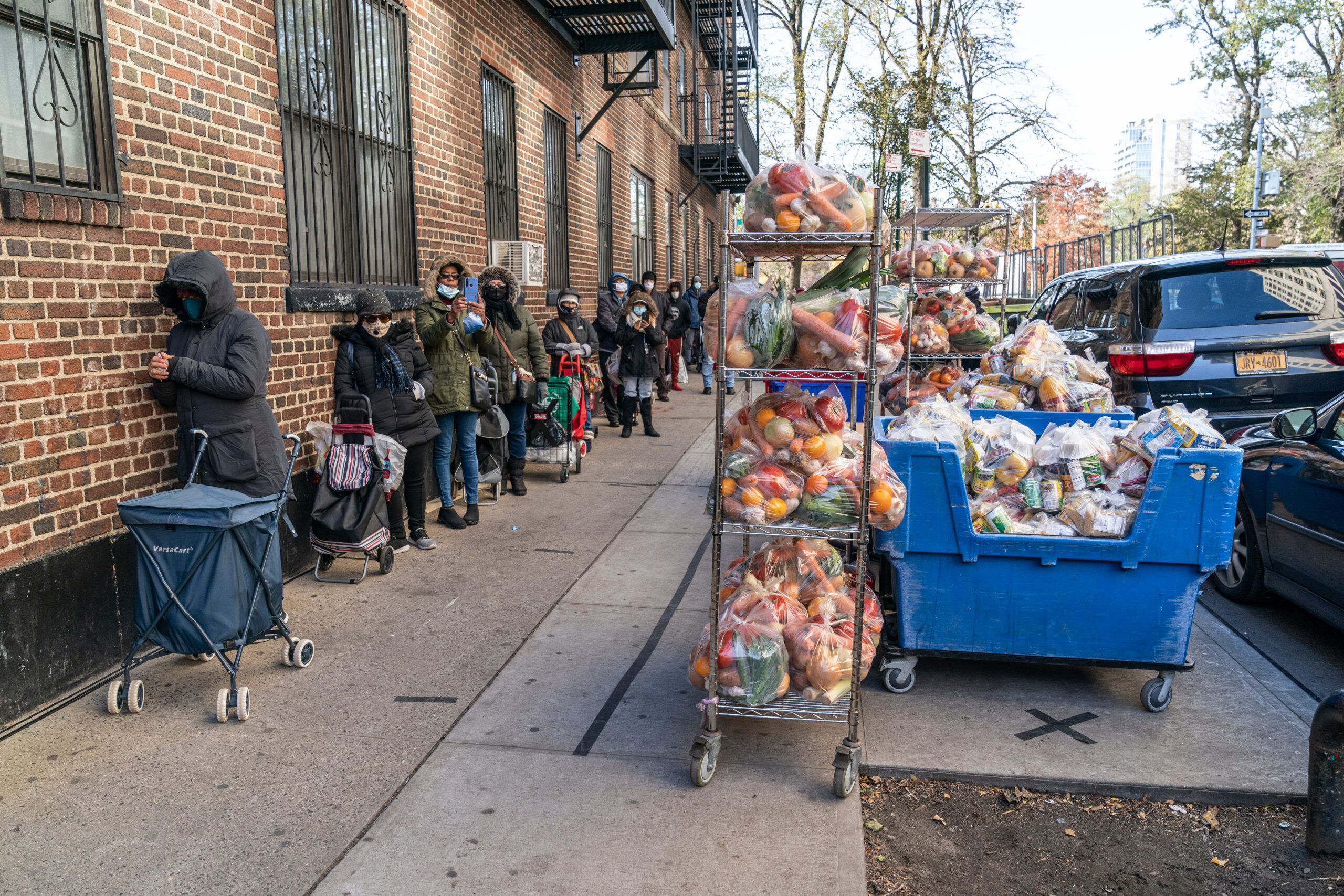
The implementation of ABAWD requirements is occurring alongside sustained food-price inflation and the lingering effects from a November 2025 SNAP payment delay that temporarily disrupted benefits for approximately 1.8 million New Yorkers. During that period, emergency food providers across all five boroughs reported increased demand, reinforcing already elevated reliance on pantry systems.
Food prices in New York City remain more than 25 percent higher than they were pre-pandemic, with persistent increases in staple categories including dairy, protein, and fresh produce. While inflation has moderated from peak pandemic levels, costs remain elevated relative to wages for low-income households, limiting their capacity to absorb benefit-timing disruptions or reductions.
Emergency food providers report that these pressures are already reflected in sustained demand across pantry networks. Leslie Gordon, President and CEO of Food Bank For New York City, said, “The compounding pressures on New York City families are immense.” She noted that demand at pantries and soup kitchens is up to 80 percent higher than before the pandemic. “Seniors, families, and working New Yorkers are being forced to choose between medicine, rent, and food,” she said. Gordon also pointed to a widening gap: “SNAP participation continues to decline even as need grows, and that gap falls to us.” She added that food insecurity is expected to increase as ABAWD households begin to lose benefits.
Advocates say the scale of SNAP reductions, combined with persistent food price inflation, is likely to intensify pressure on both households and the city’s emergency food infrastructure. The changes are expected to affect not only eligibility status but also broader household stability and local food economies that rely on SNAP purchasing power.
Joel Berg, CEO of Hunger Free America, criticized the policy shift. “It’s unconscionable that veterans, young people aging out of foster care, and older adults just before retirement will lose food assistance if they happen to be unemployed,” he said. He warned that the changes will “dramatically increase hunger in New York and America.” Berg also noted economic ripple effects, saying farmers’ markets and grocery stores will suffer from reduced SNAP spending. “It’s both morally appalling and economically counter-productive,” he added.
Looking longer term, Wimer and Yera highlighted broader impacts on poverty. “Soon, nearly 70,000 New Yorkers could be pushed into poverty every year as a result of the federal SNAP cuts,” they said. They emphasized that many affected individuals are working but earning too little to make ends meet, and rely on SNAP to remain above the poverty line while managing serious health challenges.
SNAP Implementation and Administrative Impact
New York City guidance emphasizes continued SNAP enrollment during the tracking period, with compliance determined through monthly reporting and verification systems, which increases administrative responsibility for documentation and recertification processes, particularly for workers in variable-hour, part-time, or informal employment arrangements.
As of 2025 caseload data, New York City continues to account for approximately 1.8 million SNAP recipients, with the highest concentrations in the Bronx and Brooklyn. Borough-level enrollment remains uneven, with Bronx communities continuing to have the highest rates of SNAP participation in the city.
These geographic patterns are shaping how ABAWD implementation is experienced, particularly in high-enrollment neighborhoods where administrative burden and benefit volatility are more concentrated. In neighborhoods with high SNAP density, especially in the Bronx and central Brooklyn, local offices and community partners are processing a disproportionate share of compliance documentation, recertifications, and case updates. This concentration can contribute to longer wait times, delayed case actions, and a higher incidence of procedural closures tied to incomplete or untimely reporting. For households, this often means more frequent benefit interruptions, greater reliance on emergency food between issuance periods, and increased uncertainty about month-to-month food access, even when they remain eligible under program rules.
Household Adaptation and Food Access Strategies
Citywide emergency food systems operate through nearly 800 food pantries, soup kitchens, and mobile pantry sites, which continue to report sustained elevated demand across all five boroughs, with the highest volumes in the Bronx, Brooklyn, and Queens. Food Bank For New York City reports that pantry demand remains significantly above pre-pandemic levels, with visits increasing sharply since 2019 and remaining elevated into 2026. City Harvest reports similar patterns, including increased repeat pantry use and earlier-month reliance on emergency food, indicating that SNAP benefits are not consistently lasting the full month for a growing share of households.
Households are increasingly relying on emergency food even when they remain employed or continue to receive SNAP benefits. Providers report that both earned income and assistance are less consistently covering monthly food needs. Judy Secon, Deputy Director of New York Common Pantry, said, “We are seeing more families and individuals who are working or receiving benefits and still relying on the pantry.” She added that rising prices are a central concern: “Pantry members consistently tell us that food prices are too high, and that pantry distributions are helping fill that gap.”
At the household level, adaptation reflects a layered combination of formal and informal strategies. SNAP remains the primary benefit where available, supplemented by emergency food, extended family sharing, bulk purchasing arrangements, and mutual aid networks. Some households report using credit or deferred payment systems to manage grocery costs, introducing additional financial strain over time.
For many households, emergency food has become a recurring component of monthly food access rather than a temporary supplement, particularly in neighborhoods with high SNAP enrollment density in the Bronx and central Brooklyn.
Administrative Barriers and Shifting Food Security in New York City
Even under phased implementation, administrative requirements continue to shape SNAP access. Recertification rules, reporting obligations, and documentation standards contribute to “churn,” whereby eligible individuals cycle on and off benefits because of procedural barriers rather than changes in eligibility.
For workers with irregular schedules or informal employment, documenting 80 hours of qualifying activity can present ongoing challenges even when requirements are being met. As a result, observed benefit loss reflects both changes in eligibility requirements and administrative friction within the system.
Combined with sustained food price inflation and residual effects from the 2025 SNAP disruption, the March 2026 SNAP changes are contributing to a more fragmented and less predictable food access landscape across New York City.
For many New Yorkers, the issue has shifted from qualifying for SNAP to maintaining consistent access to benefits under the new rules. When benefits are delayed or interrupted, households rely more on emergency food systems, informal networks, and other precarious coping strategies to fill the gap.