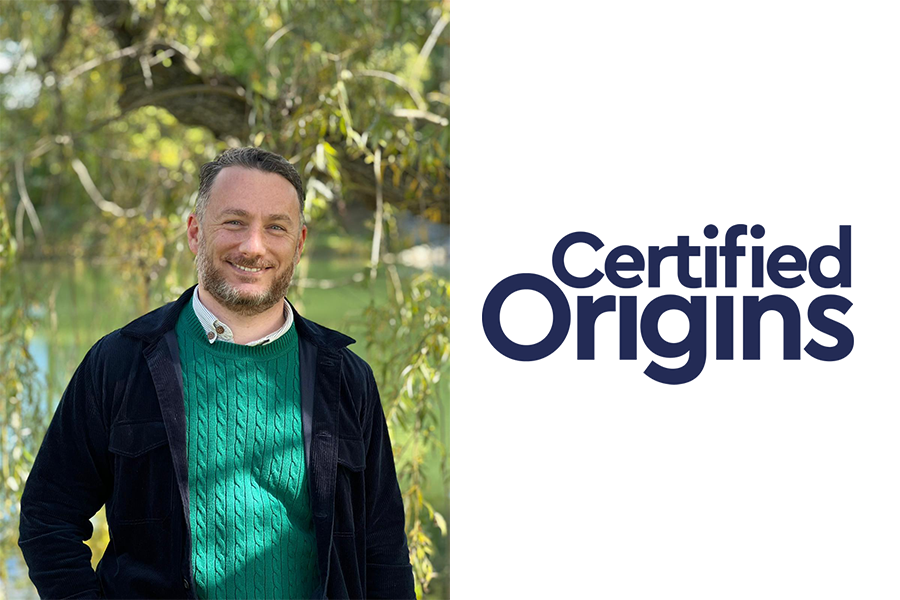
Certified Origins is a private label supplier founded in Tuscany, Italy, with the goal of creating transparency in the food supply chain and providing ethically-sourced olive oil to foreign consumers while supporting local farmers’ cooperatives. The company has now expanded its presence across Europe, North America, and Asia. We sat down with Giovanni to learn more about how some global food distributors and policy makers are working to improve traceability, quality, and access in a supply chain where the ever-growing demand for imported products, along with a political environment that values a conservative agenda over public health, means that nutrition often comes at the expense of patrons, producers, and even the land itself.
Food Policy Center: What made you want to work in the olive oil industry?
Giovanni Quaratesi: I’ve always been passionate about food. In high school I studied classical studies—Greek and Latin, history, philosophy. I ended up studying Asian studies in Rome—arts, literature, anthropology, Japanese language, which I abandoned at some point because it was too hard. I tried to get into journalism. It wasn’t really a profitable business, at least, the way I saw it back then. I ended up getting a scholarship to go to Australia and be an Italian teacher for primary school kids in Melbourne. After that I stayed, and I found a job with a small company selling wine-making equipment, olive oil-making equipment, tomato sauce-making equipment to immigrants in Melbourne. That’s where I learned two things: one, I really liked to work with food and, two, I was good at sales. When I decided to end my experience in Australia, I ended up working in Thailand for a six-month project on geographical indications.
Back then—and they still do—Europe was promoting heavily the concept of “GI,” geographical indications. For example, how do you say “Champagne” is Champagne? Or “Parmigiano Reggiano” is Parmigiano Reggiano? Or feta? Or tequila? You have to have a legal system that protects producers from that area that has gained a reputation of hundreds or thousands of years of making that thing a certain way so they can keep doing what they’re doing without being threatened by somebody else who puts their name on a label and sells it as the same thing.
Europe has invested an incredible amount of money to develop, protect, their food production. But Geographical Indications also exist in many other countries, and the Thai government was working to identify food products in Thailand that it would make sense to protect.Thailand now has several GI products, like Jasmine rice, a bunch of fruits like pineapples, a specific kind of banana.
That’s how I got familiar with the GI concept and really fell in love with protecting farmers and products by linking the food to a community rather than a specific producer. That’s the strength, or beauty, of the GI system. You don’t necessarily link it to a company, you link it to a terroir and a community. So a cooperative can easily apply to those GIs, and they can make more money because they are in the position to say, “This is the real thing,” and they can ask for a premium in the market.
I tried going back to Italy a few times, but that didn’t work. I wanted to go and work for a food company abroad, and Certified Origins just happened to be looking for someone to promote the olive oil brand that they were developing outside of Italy. Then I was asked to come here to the
US and help with the US-side of business. I work in the capacity of a spokesperson—in the US, a “lobbyist” is probably the best word to define it. I entertain relationships between institutions, other companies, partners, potential partners, and oversee anything that gets communicated about our company outside of our company.
FPC: Can you tell us more about “cooperative” farms and what benefits they might have for farmers and even companies like Certified Origins?
GQ: The cooperative model is something that emerged in a strong way after World War II. When people had nothing, one single farmer could not afford to buy a truck or an olive mill or wine mill. A cooperative applies to different categories, not just olive oil. Europe was devastated after the War—internal division, bombing from Allies and enemies alike—so lots of things had to be rebuilt. People decided to create organizations and put money together to buy a truck or an olive
mill or a building together to help one another to get back on their feet. In Europe it was popular because of economic reasons. If you look at the size of cooperatives and how they operate, for olive oil specifically, the size can vary quite a lot.
Within the cooperatives, you can have a wide range of farmers. Somebody that has a few trees or someone that has thousands and thousands of trees. As a principle, cooperatives usually exist for the purpose of serving their farmers. They usually own a mill where a farmer can bring their own olives and make their own olive oil using the services of the cooperative without having to shop around. They usually help farmers do quality control and agricultural planning. They help them do the paperwork in case they want to apply for some certification. They can participate in training for how to use certain products like fertilizer or pesticides. They can help in accessing better prices for fuel, fertilizer, agro-chemicals. They can help network, and in some cases, like cooperatives we work with, they help farmers to develop their own brand. They develop their own bottle, their own label, that the farmers can sell as they wish, or leave their olive oil to the cooperative who will sell it and then share the profit with the farmer. Or they can bring their own containers and get the oil milled and bring it back home.
Most cooperatives by law are not meant to sell olive oil that comes from other origins, meaning: cooperatives are not purely commercial entities. Even if you are a super successful cooperative in Tuscany, you will try to sell only Tuscan olive oil. That’s where companies like ours come in, because we are full commercial entities and have more freedom to work with cooperatives from other origins. So if I want to work with farmers from Tuscany, I can, but I can also work with farmers from Spain, Puglia, Greece, wherever, because I’m not linked to the cooperative, which, by law, has to serve only the members of the cooperative itself.
Another important element in Europe is that the cooperative allows you to access funds. meaning that the European Union, or the Italian government, or both, will release funds in support of agriculture if you apply [as a cooperative].
FPC: Have you seen anything like a cooperative in the States?
GQ: There are some models, but you have to think of the context of land-ownership in the US versus Europe, and the approach to capitalism. Cooperatives have some form of socialism and even the word here will raise some eyebrows. It’s not something I think will take hold in the US as easily as other forms of aggregation.
FPC: How is Certified Origins working with the framework of GIs from its base in North America? In addition to looking at protected and popular products (not GIs, but similar) like Vidalia onions and bourbon, what about certain foods produced by First and Indigenous Peoples (for example: manoomin (wild rice) or certain cultivars of peaches from nations in the Southwest)? In other words, how might GIs aid in providing agency outside of a white, European, or capitalist culture on this continent?
GQ: Olive oil trees are native to Central Asia and became part of North African, Middle Eastern, and European farming and food traditions thousands of years ago. Thanks to native and indigenous communities who traveled, traded, and kept these food traditions alive across history, today we can still enjoy olive oil around the world and it’s now cultivated in even more countries by native, local farmers.
From a business perspective, and limited to Certified Origins’ expertise and history today, we are not currently sourcing GI products from North America—US, Mexico, Canada. A serious and reliable food company cannot improvise expertise without first building the skills, relationships, and years of local connection needed to work responsibly with a specific product and source. Our company is still young—less than twenty years—and our core expertise comes from the cooperatives of farmers in the Mediterranean that founded the company itself, and from the culture and territories where we operate.
More generally, outside of Certified Origins’ scope and beyond olive oil, I do think GIs can support local agency and protect cultural and territorial value outside of Europe. But it’s not one-size-fits-all: you have to look at each country and each product case by case, including who defines the rules, who controls the governance, and who benefits economically and culturally.
And to your broader point, GI-type protection already exists globally, through sui generis systems or trademark-based systems, in many countries across Europe, Asia, Africa, and Latin America, including Turkey, Georgia, Moldova, Ukraine, China, Japan, South Korea, India, Mexico, Brazil, Argentina, Morocco, Tunisia, South Africa, and many others. We can only hope that these success stories, like the GIs created by native farming communities in Europe and the African continent, India, China, Mexico, et cetera, supported by local governments, businesses, and institutions, will serve as inspiration for many other farming communities around the world to do the same.
If done responsibly, with the community leading the process, GIs can help preserve traditions, support quality production, and commercialize products in a way that keeps more value tied to the territory and the people behind it. It’s a legal, political, cultural and economic model that can be used as a guideline and an example for other countries that are interested in doing something similar in their own unique context and culture, respecting their own prerogatives and priorities.
FPC: From the perspective of large- and small-scale olive oil production, what does the everyday person who buys your products not understand? What about olive oil policy and diplomacy isn’t so obvious?
GQ: There are two big “chunks” of policy in olive oil. One is the production part. So if you look at Europe, whenever I interact with European entities, whether farmers, cooperatives, regions, or governments, what usually comes up is: “How can we guarantee that our product is not being counterfeited? How can we support farmers to do what they do and make more money? How can we avoid abandonment of olive farms?
Policy can help: European funds, GI protection, education for farmers. We are trying to figure out how to get Tuscan farmers to become “carbon farmers” as well. So how they can become farmers of carbon credits, not just olives. That will allow the farmers to have two sources of income. One from the olive oil and one from the generation of carbon credits, which they could eventually sell to companies. The beauty of carbon credits is that they are not linked to the productiveness of the trees. So bad crop, good crop, you still have the credits.
When you look at countries like the US, where the production is small, but it is the second-largest consumer of olive oil, despite 50 percent of the population not using it, the upside is still huge because of tariffs and the lack of regular quality control . Most of the countries that consume olive oil are part of the International Olive Council. It’s the only global non-profit organization that provides guidance in terms of quality standards, testing, and everything related to olive oil. The US is not part of it. So there’s no clear, national guidelines for producers. Companies like ours will rely on IOC standards, but California is creating their own. So there’s a little bit of a policy challenge there on who’s going to lead on the definition of “quality,” how we can define “extra virgin” and “virgin” and so on.
FPC: It’s no secret that the Trump administration has unleashed a lot of tariffs, even on our allies. How has that affected what you do and how you see policy?
GQ: You have to unpack it in different areas. To my knowledge there’s only one organization that has applied for GI protection in the US. Everyone else works under a branded legal infrastructure so they will register a brand and not the geographical indication to protect a certain production. The reason why the US is against [GIs] is mainly because the dairy industry has a very strong feeling that terms like “Parmigiano” or “feta” or “Gouda” should be generic and not linked to a specific territory or a specific way of production.
So you have a strong, powerful industry that, ironically, was founded in many cases by immigrants, competing for the same market share with farmers “back home” who are doing the “authentic” thing, or trying to. In Europe, if you’re a producer, or a consortium, if you see somebody imitating your [protected, regional] product, you can go after them legally.
There’s a shop and a company here in the US called Sogno Toscano. They sell and market a wide range of products under the Tuscan name, even if they’re not from Tuscany. Legally, here they can absolutely do it. In Italy, in Europe, they would not be able to do it. They benefit from the reputation of Tuscany, but they don’t necessarily send any money back to Tuscany. Tuscans are saying, “You’re using my name, I should benefit somehow.” But this is not related to the Trump administration. It’s always been an issue that the US and Europe have tried to figure out. This administration, I think, mentioned GI specifically in the Big Beautiful Bill, with several pages against GIs and what they represent.
The second aspect is tariffs. Tariffs work in a negative way for consumers. One way is because it simply makes a product less accessible to whoever imports it or consumes it. Tariffs are not on European farmers, tariffs are on US consumers or businesses.
The immediate impact is increasing cost. The second impact is that you are making a case for other oils. Those few Californian producers that are here are also going to increase their cost because we are in a profit-driven society and economy. If Italian olive oil, Spanish olive oil, goes up, even if I’m a California producer, I’ll obviously match that price or get just a little under, which is absolutely legitimate and the right thing to do. Obviously the consumer will not benefit from it, but that’s what’s going to happen. And that applies to pretty much any food or goods.
The other issue, which is the one that actually concerns the industry the most here in the US is: are we going to lose what we gained with fifty years of hard work and education? Are virgin and extra virgin olive oils going to grow in terms of consumption or are we going to see more seed oils or other oils gain ground again? We already started seeing it two years ago. Last year and the year before the crop in Spain was bad, so prices went up a lot. And we saw the lowest income groups dropping olive oil and going back to seed oils. In that case the cost was higher because of the crop cost. It was an issue of the origin. The tariffs are another kind of increase, an artificial increase that comes from taxes. What will that look like in terms of accessibility? We’ll still have to see. It’s too soon to say what the full impact will be.
I think we’re going to start seeing new pricing and listings in the next three full months. This is not just for olive oil. When a tariff hits, the cost does not immediately get transferred to the consumer. First companies start to hold the price. There is a case to be made for an exemption on tariffs for olive oil.
The hope in the industry is that, although there’s clearly not an interest right now in removing those tariffs on olive oil, there will be an internal movement within the White House and an interest in the American population where they will say, “We do recognize this crop is healthy, this product is healthy, or healthier than other oils and fats; we do recognize the production in the US is not sufficient today for the need of the market and the American people.” It makes no sense to have a “tax on health” because basically that’s what it becomes, taxing health.
If you think about the MAHA movement, olive oil should be part of it. It’s very hard to find anything bad to say about it. It goes with dairy, it goes with protein, it goes with veggies, so it’s a very good complement for all the ingredients that have been put at the top of the new upside-down pyramid. So why are we taxing it in such a strong way?
There’s not that much money to be made on olive oil. A 15 percent, 25 percent tax markup, is a substantial shock for olive oil producers. If you had to eat those margins as a company, as a producer, as a farmer, you would absolutely be out of business in months. You have to transfer that cost to the end consumer. There’s no way around it.
FPC: Can you tell us more about how you see tariffs as a “health tax” ?
GQ: The math is simple: it’s a product that is not available in the country; it’s a product that you’re recognizing as healthy and beneficial. You put that ingredient at the core of the health guidelines and then you tax it. There’s a fundamental contradiction there, because if you recognize that the product is healthy, you should find ways to subsidize it. Supporting consumption is growth in the industry. For California producers and importers alike—it doesn’t have to be one or the other. The only geographic region in the US so far to be able to produce olive oil is California, because of the Mediterranean-like climate. Same as for wine. Even if you go super fast with hyper-intensive-super-monocrop-fastest-farming-option out there for olive oil, the production cycle is about three, four years to get trees in production. If right now California produces about 5 percent of what the US consumes, with consumption trends that are going up, in the short term, even in ten years, there is not enough local production to meet demand. So the only solution is to keep working with importers who are businesses like ours, who are invested in the US and include people like me who have relocated to the US and want olive oil. That’s why I say you are “taxing health.”
FPC: On your website you list the blockchain as something that is front-and-center for Certified Origins—something that has died out in a lot of popular media. Can you speak to how Certified Origins uses that technology?
GQ: When you do a commercial transaction with a shop—small, large, enormous—you’re trading money and trust. When you apply that to how retail has evolved—and this is also my food studies Master’s degree kicking in–there’s been an evolution from having that one-on-one trust relationship with a shopkeeper—like, “I trust that guy. I’m going to buy things from him because he says it is what it is”—to now shopping in giant stores where the selections are extremely vast. With that, the trust link is very much stretched. How do you bring back that level of trust?
Paperwork—photocopies, emails, folders, digital folders— is one thing. It works, but it can be manipulated. Shared, blockchain-based ledgers cannot. At least they cannot be changed without triggering communication to everybody whose ledgers are shared on blockchain. If you buy olive oil from a company whose data is completely internal, you must trust that they’re doing the right thing. But if you’re buying olive oil from a company that uses blockchain-based traceability, that company is sharing the responsibility of the data across the whole supply chain from the farmer to the miller to the storage guy, the bottler, and so on.
Another way to insure traceability is paying a third-party, which we also do in some cases. Or using certifications like the GIs. That’s where the blockchain kind of tries to make the supply chain more transparent. Large chains in the US—Walmart—because their supply chain is so large, when they had an issue with recalls, it took them so long to trace back the origin of the issue using traditional paperwork, that by the time they figured out where the issue was, they had to shut down entire production lines and remove a lot of stuff. It was very expensive. Walmart and other stores approach blockchain-based traceability from the perspective of risk management and control. We approach it as a sales tool and a conversation with the consumer, saying, “you can trust us.”
The very first product we sold to the US was PGI Tuscan extra virgin olive oil, an authentic Protected Geographical Indication, in a market full of imitations. So we could go to the US and say our oil was from Tuscany with a real PGI seal. Even if it’s not recognized by the US government, it is recognized by US consumers.
So for us, blockchain-based traceability is simply another tool that says, “Whatever I put on this ledger and information about this product cannot be corrupted.” If someone tries to change something, we will know about it. That gives us peace of mind, but also we use it as a commercial tool to say, “Hey, buy from us, we have an extra level of trust.” That’s how we approach it.
FPC: When we talk about traceability, we often talk about origin or sustainability. While many Italians might be familiar with the ongoing issues surrounding ethical labor practices in the country, it is not widely known in the States. This includes caporalato or enslaved labor in regions like Puglia or Veneto, the extensive and documented abuse of South Asian and Sub-Saharan African immigrants, and even outsourced Uyghur forced labor in East Turkestan. When it comes to tracing working conditions, how do you address this issue?
GQ: Most of the global retailers that we work with do ask those questions and they do come to visit the farms personally. If you work with US retailers—I’m talking the big ones, the big names—they’re surprisingly cautious about who they start doing business with, especially companies like us who supply private label brands. When you do private label, you’re, in some way, an extension of the client or retailer because the client is trusting you with their brand. They’re saying, “Okay, you’re going to do this for me, and you’re going to use my name on that product.” When they start working with a company like ours, they really want to come and see if what you say is true. The vast majority of food buyers will actually come visit at least once a year in different locations, and they will force you to pay third-party organizations they choose to come and check your supply chain. There are international standards like International Featured Standards, British Retail Consortium; there are third-party audits and indications that address those issues you mentioned, like safety. At Certified Origins, we also developed a series of internal audits that we do with our suppliers. We do some tomato sauce, we do other products, so we’re very well aware of the challenges there can be in sourcing. We tend to always work with the same suppliers. We do not like to shop around too much. It takes a lot of talking and knowing and visits before we fully onboard a supplier. We don’t just buy something from a supplier because the price is right. We are responsible for not only for our reputation but also our clients’.
It comes from wanting to do the right thing. This is one of the reasons why we are not the cheapest player on the market, but we are still able to work with selected retailers who understand what we do.
Giovanni Quaratesi is a global affairs executive and good food ambassador representing Certified Origins worldwide, working at the intersection of food policy, sustainability, and international trade with an expertise in private label programs, GI-certified foods, and extra virgin olive oil. He advises on policy engagement, market access, and strategy to advance transparent sourcing, Mediterranean diet heritage, and value-added exports. To find out more about Certified Origins, you can visit their website here.