
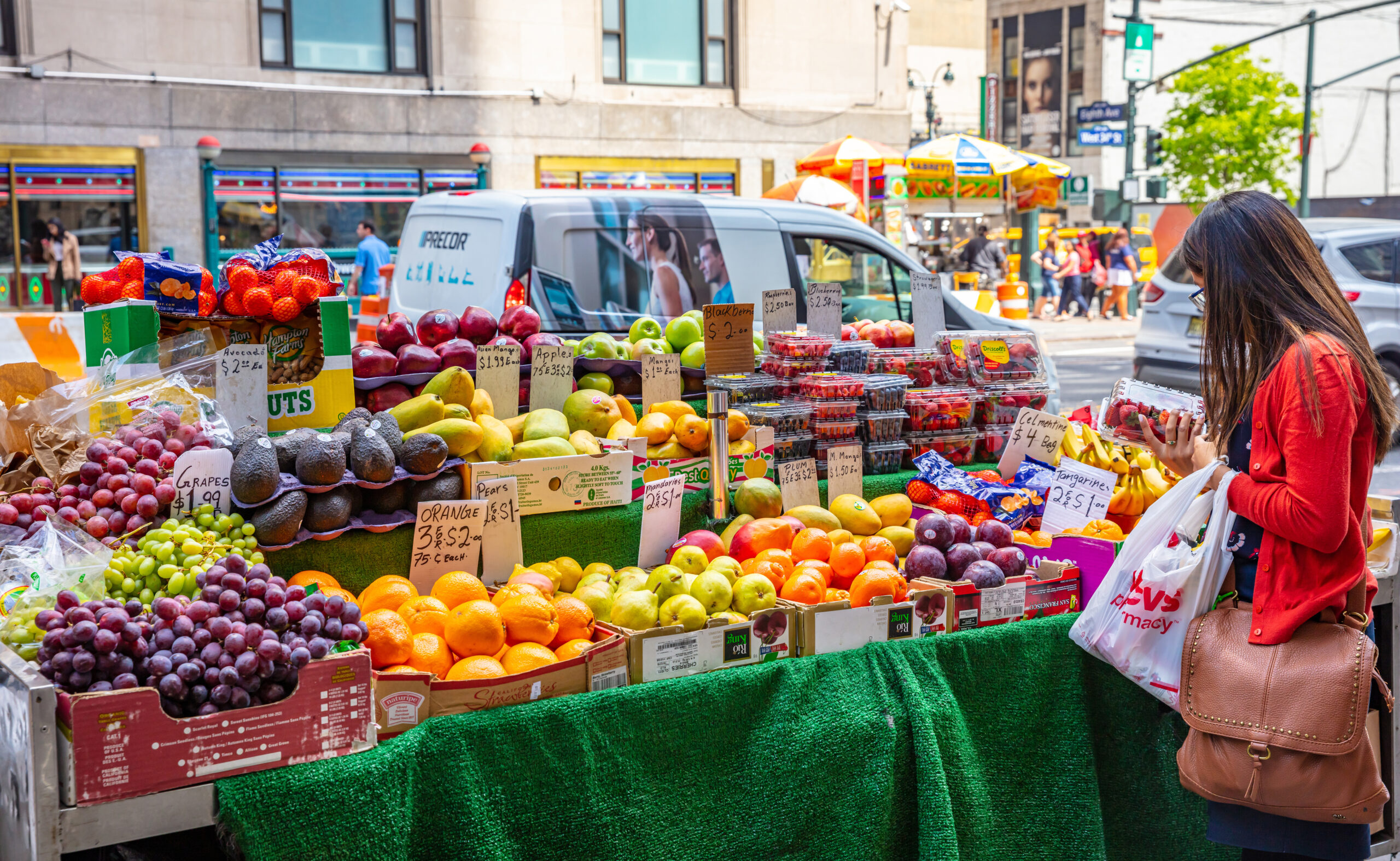
Roughly 19 billion pounds of food pass through New York City each year, making the five boroughs one of the largest centers for food consumption and commerce on the planet. But all that food carries a significant carbon and environmental footprint, which a new strategy from City Hall aims to shrink while also improving New Yorkers’ health.
The Mayor’s Office of Food Policy just released its first comprehensive Food and Climate Strategy, a document that reframes food as both a driver of and potential solution to climate change. The Strategy is organized around three goals: reducing the climate and environmental impacts of what New Yorkers eat, reducing food waste and diverting it from landfills, and building a food system that can withstand climate-related shocks and disruptions. The report takes stock of the existing work being done in each area and offers more than two dozen new ideas for going further.
Here’s an overview of the Strategy, its three goals, why they matter, and how the city plans to achieve them:
1. Reducing the Climate and Environmental Impacts of What New Yorkers Eat
According to New York City’s 2023 integrated greenhouse gas inventory, food production and consumption generate 20 percent of New York’s total emissions, the third largest source, behind only buildings and transportation. Globally, food systems are responsible for about a third of all emissions.
Every stage of the food chain contributes to these emissions, from manufacturing fertilizers to refrigerating trucks to decomposing waste in landfills. But certain foods carry far higher emissions than others: red meat, especially beef, and dairy are among the most carbon-intensive. They also have an outsized environmental impact beyond emissions. Producing meat and dairy requires vast amounts of land, much of it converted from forests that would otherwise absorb carbon and support wildlife. For example, cattle ranching is the leading driver of deforestation in the Amazon. Meat production also demands enormous quantities of water: a single pound of beef requires roughly 1,850 gallons of water on average globally, according to research from the Water Footprint Network.
The Strategy aims to reduce these climate and environmental impacts by changing what city agencies purchase and serve, by encouraging New Yorkers to consume more plant-based diets at home and in restaurants, and making food distribution and storage infrastructure cleaner and more efficient.
Changing What City Agencies Purchase and Serve
According to the Strategy, New York City’s government is one of the largest institutional food purchasers in the country, spending roughly $500 million a year to feed its schools, public hospitals, older adult centers, after-school programs, child-care centers, shelters, and correctional facilities. Together, these agencies serve more than 200 million meals each year.
This scale means that the city’s purchasing decisions ripple outward, shaping what suppliers grow, how they produce it, and what products they develop. The Strategy aims to leverage that purchasing power to cut emissions from city food procurement by 33 percent by 2030, a target set in PlaNYC, the city’s 2023 climate plan. Because healthy, whole-food plant-based diets are better for both health and the environment, the Strategy calls on city agencies to serve more whole and minimally processed plant foods and fewer animal products, particularly beef and dairy.
Several agency programs have already shifted toward plant-forward menus. NYC Health + Hospitals has served over two million plant-based meals as the default option, cutting food-related emissions by 36 percent, saving 59 cents per meal, and earning 90 percent patient satisfaction. NYC Aging and NYC Public Schools have also expanded plant-forward options, with schools cutting per-student emissions by 40 percent between 2018 and 2022. The Good Food Purchasing initiative now requires vendors to share detailed data on food origins and supply chains, and the city has started to adopt best-value procurement, which allows agencies to weigh taste and sustainability alongside price. Overall, the city reports it has already achieved a 29 percent reduction in its food procurement emissions from its 2019 baseline.
Going forward, the Strategy proposes continuing these programs and expanding them to additional agencies, tracking procurement emissions annually, reducing reliance on ultra-processed foods, increasing on-site cooking, and working with food manufacturers to develop low-emission products. It also calls for building the city’s capacity to assess how food purchases affect water use, land use, biodiversity, and pollution, and for exploring adopting seasonal procurement calendars and including carbon footprint and emissions-based metrics in purchasing criteria.
The Strategy isn’t calling for meatless city kitchens. It acknowledges that food decisions involve tradeoffs: nutrition, cost, cultural meaning, and environmental impact don’t always point in the same direction. Local sourcing, for instance, may not always minimize emissions–a tomato grown in a heated greenhouse upstate can have a larger footprint than one shipped from a warmer climate. But buying locally strengthens regional farm economies and builds relationships that matter when supply chains break down. When agencies do buy animal products, it encourages choosing suppliers with strong environmental and animal welfare practices.
Encouraging New Yorkers to Change What They Eat at Home
City-served meals represent only a fraction of what New Yorkers eat, so the Strategy also aims to shift eating patterns more broadly by encouraging households and private food businesses to choose more whole and minimally processed plant foods.
For consumers, this means expanding programs that make healthier, lower-emission foods more affordable and accessible. Health Bucks provide bonus credits for produce purchases at farmers’ markets. Groceries to Go helps older adults and people with disabilities to access fresh food. And the plan calls for continuing public education campaigns like “Eat a Whole Lot More Plants” and expanding nutrition programs for families with young children. It also supports growing the city’s community garden network through the GreenThumb program, giving more New Yorkers direct experience with how food is produced. For private restaurants and food businesses, the Strategy is less directive but signals a clear priority: more plant-forward options, more whole foods, less processing.
Making Food Infrastructure Cleaner and More Efficient
The third approach targets the systems that move, store, and prepare food throughout the city. Getting food from farms to tables requires energy at every step of the way: refrigerated trucks and warehouses, commercial kitchens, and delivery vehicles. Much of this infrastructure in NYC still runs on fossil fuels. The Strategy, therefore, envisions a broad shift toward electrification and efficiency. This includes helping New Yorkers switch from gas stoves to induction cooktops, incentivizing delivery companies to adopt electric vehicles, expanding bike lane networks to support cargo bike deliveries, and investing in more charging infrastructure and efficient refrigeration across city facilities.
2. Cutting Food Waste in Half and Keeping All of It Out of Landfills
Food waste accounts for 21 percent of New York City’s residential waste stream. All of that wasted food represents wasted resources: the land, water, energy, and labor that went into producing it. And when food ends up in a landfill, buried under layers of other waste without exposure to oxygen, it produces methane, a greenhouse gas that traps about 80 times more heat than carbon dioxide over 20 years. An estimated 58 percent of methane emissions from municipal solid waste landfills come from food waste.
The plan sets two targets for this second goal: cut citywide and per capita food waste in half by 2030, and divert 100 percent of what remains away from landfills. The first goal requires preventing waste before it happens. The second requires processing whatever waste does occur into soil-enriching compost or renewable energy.
Preventing Food Waste
Cutting citywide and per capita food waste in half by 2030 requires interventions at every point where waste occurs: city agencies, private businesses, food rescue organizations, and private households.
Several prevention and rescue programs are already underway. Share Tables in public schools let students leave unopened items for classmates or food bank donation rather than throwing them away. Plastic Free Lunch Days, an initiative started by fifth graders in Red Hook, have spread across the elementary school system, reducing packaging waste as well as food waste. The Department of Sanitation’s donateNYC Food Portal connects businesses with surplus food to organizations that can redistribute it, and the city’s network of food rescue organizations, including City Harvest and the NYC Food Bank, work to capture and redistribute edible surplus across the city.
For city agencies, the Strategy proposes systematically analyzing where and why food goes uneaten and deploying targeted fixes: technology to track waste, software to predict demand more accurately, staff training, and surveys to learn why people leave food on their plates. It also suggests replacing individual milk cartons with bulk dispensers to cut packaging and cost.
For the private sector, where most food waste reduction currently happens voluntarily, the Strategy proposes financial incentives like rebates or tax breaks for businesses that meet reduction and diversion targets. It also calls for promoting imperfect produce at farmers’ markets, for example, by giving shoppers extra Health Bucks credit when they purchase misshapen fruits and vegetables that might otherwise be thrown away.
The Strategy also targets single-use packaging. It calls for expanding Plastic Free Lunch Days in schools, eliminating plastic packaging from city-provided meals where possible, encouraging pilot programs for reusable takeout containers, and supporting Extended Producer Responsibility legislation that would hold food packaging manufacturers accountable for the waste their products generate.
Diverting 100 Percent of Food Waste From Landfills
Prevention only goes so far, and food scraps that get thrown away need to stay out of landfills and instead be composted or converted into biogas. Composting transforms food scraps into nutrient-rich material that improves soil, keeping carbon locked in a useful form rather than releasing it as methane. Biogas facilities go a step further by capturing the methane that decomposition produces and using it for energy, thus turning a climate liability into a renewable fuel source.
Significant infrastructure is already in place. In October 2024, New York launched the largest residential curbside composting program for food waste in the country, making curbside composting available to all residents in all five boroughs. The Commercial Waste Zones program, which divides the city into zones served by designated private carters, requires businesses to separate food scraps for composting.
Going forward, the Strategy focuses on increasing participation in curbside composting across all five boroughs while maintaining low contamination rates and proposes additional incentives, such as rebates or tax abatements for businesses that exceed diversion targets. It also calls for expanding processing capacity by continuing work on the Staten Island Compost Facility, supporting biogas projects like Newtown Creek’s biogas-to-grid initiative, and incorporating food waste processing into the redevelopment of the Hunts Point Produce Market. The city aims to achieve 100 percent diversion at all city-owned properties and facilities, while continuing to support community composting programs and distribute finished compost to parks, community gardens, and residents.
3. Building a Food System That’s Resilient to Climate-Related Shocks and Disruptions
The third goal is to adapt the city’s food system to withstand shocks and disruptions caused by climate change. Unlike the first two goals, which focus on reducing the food system’s climate and environmental footprint, this one focuses on protecting the food system from the droughts, floods, heat waves, and supply chain disruptions that climate change will bring.
New York’s food arrives from all over the world: California lettuce, Florida oranges, Chilean grapes, Mexican avocados. That global reach provides variety and low prices, but it also means that distant disruptions can ripple back to local grocery shelves. A drought in the Central Valley or a port strike in Long Beach affects what New Yorkers find at the store. Roughly 95 percent of food enters the city by truck, so a single storm that closes bridges and tunnels can cut off the supply.
The Strategy highlights how quickly the city’s food supply can be disrupted. Hurricane Sandy flooded grocery stores and food pantries and exposed weaknesses at Hunts Point, the city’s main food distribution hub. COVID-19 overwhelmed distribution systems with supply chain bottlenecks and runs on grocery stores–but also revealed the city’s adaptive capacity, as it distributed more than 200 million emergency meals with community organizations scaling up rapidly to help.
In the years since Sandy, the city has significantly strengthened its food infrastructure. A $630 million redevelopment of Hunts Point is now underway. The FRESH program has supported 45 new or renovated food retail spaces in underserved neighborhoods. And the New York State Regional Food Hub, a 60,000-square-foot cold storage facility that opened in 2025, is connecting small and mid-sized farms to over 370 distribution partners in the city.
Because these emergency response systems are already in place, the Strategy focuses on proactive measures to build resilience before the next crisis. This means preparing for both sudden shocks like hurricanes and slower-moving pressures like rising temperatures, unpredictable rainfall, and increasing fuel costs. To do this, the city outlines three overarching strategies: diversifying food sources, strengthening distribution infrastructure, and supporting sustainable farming in the regions New York depends on.
Diversifying Food Sources and Strengthening Regional and Local Foodsheds
The city aims to build up local and regional food sources and ensure food can reach New York through multiple pathways if supply chains break down.
For city purchasing, the Strategy proposes flexible contracts that let agencies switch suppliers quickly during emergencies and calls for each agency that serves meals to develop a formal food resiliency plan. But the city’s own purchasing represents only a fraction of the food consumed in New York. So the Strategy also proposes encouraging large private institutions like hospitals, universities, and corporate cafeterias to pool their buying power and source more from regional farms, creating stable demand that gives local producers reason to invest in serving the New York market. It also envisions communication campaigns that highlight regional producers, encouraging New Yorkers to buy from the same farms that supply city agencies.
Urban food production offers another layer of resilience. The Strategy calls for expanding community gardens and urban farms, especially on underutilized municipal land in low-income neighborhoods, creating youth education programs that connect students with food production, and supporting partnerships that help regional producers turn local ingredients into shelf-stable products that city agencies can use.
Adapting Food Distribution and Transportation Systems
The city’s heavy reliance on trucking means that when roads fail, there are few alternatives. The Strategy aims to rebuild redundancy by developing ‘blue highways’ for marine freight, supporting ferries and cargo bikes for last-mile delivery through new microfreight landings, expanding rail capacity, and mapping backup road routes in case major corridors are blocked.
At Hunts Point, the ongoing redevelopment will include electric vehicle charging stations and shore power connections to encourage fleet electrification. The Strategy also calls for surveying cold storage capacity across the city to identify gaps, supporting backup power for critical food infrastructure, and potentially expanding the FRESH program that brings grocery stores to underserved neighborhoods.
But physical infrastructure is only part of the system. The people who drive delivery trucks, stock warehouse shelves, cook institutional meals, and bike orders across the city are just as essential to keeping food moving. If they cannot work safely during heat waves, investments in roads and warehouses matter little. With that in mind, the plan proposes expanding cooling infrastructure such as shaded rest areas, exploring mandatory cooling breaks during heat emergencies, and supporting legislation requiring delivery companies to provide job-protected leave so that workers can recover from heat illness without being economically penalized.
Supporting Sustainable Agriculture in the Region
Farms face their own climate pressures: flooding, drought, seasonal shifts, and new pests. That matters for New York because the city’s food security is only as strong as the farms that supply it. The Strategy thus calls for supporting climate-smart practices like cover cropping, reduced tillage, and improved soil management that can make farms more resilient while shrinking their environmental footprint. The city can help through funding, technical assistance, and advocating for supportive state and federal policies
New York cannot regulate farms in other states or mandate practices in the Hudson Valley. But its enormous purchasing power gives it influence. When city agencies and large institutions signal they’ll pay for sustainably produced food, farmers have reason to change how they operate.
The Limits of Municipal Power & What Comes Next
Any city plan intended to transform the food system faces inherent limitations. Many of the changes that would make the biggest difference are not within municipal control. Federal dietary guidelines shape what schools can serve. Agricultural policy determines what farmers grow and how they grow it. National food date-labeling standards could reduce the confusion that leads consumers to throw out perfectly good food. On all of these, the city can only advocate.
But New York is not waiting for the federal government to act. The city’s scale gives it significant power to drive change on its own. Menu decisions made by city agencies ripple through supply chains. When eight million residents change what ends up in their brown bins, waste processing economics shift. And what works in New York can serve as a model for other cities. By 2050, an estimated 80 percent of food will be consumed in urban areas, making cities central to addressing the climate impacts of the global food system. If New York can demonstrate that plant-forward institutional meals, citywide composting, and resilient regional supply chains are achievable at scale, other cities will have a roadmap to follow.
The Strategy arrives at a moment of political transition. Mayor Adams’s term ends on January 1, 2026, and it remains to be seen what aspects of food and climate policy incoming Mayor Zohran Mamdani will prioritize. That uncertainty matters because strategies like these require sustained commitment across multiple agencies and budget cycles. The plant-based meal programs at hospitals and schools took years to develop and scale. The Hunts Point redevelopment will unfold over a decade. Whether this Strategy produces results depends on whether the next administration continues the work, although there is reason for optimism: Mamdani has signaled that climate policy and food access will be priorities for him.
The vision is ambitious: for every meal to contribute to addressing the climate crisis. Achieving that may be out of reach. But setting the goal may be what matters most–giving city agencies, businesses, and residents a shared framework for thinking about how the food system could change, and why it should.
You can read the Mayor’s Office of Food Policy’s full Food and Climate Strategy here.