The federal Personal Responsibility and Work Opportunity Reconciliation Act (PRWORA), a welfare reform law, was passed in 1996. Among other provisions, the law limits access to certain public benefits for individuals who do not meet specific immigration or eligibility requirements.
In late 2025, a reinterpretation of the law issued by the Trump administration in July began to raise concerns among food access advocates across the United States. The revision broadens the scope of programs—such as food pantries and soup kitchens, which have historically been considered part of the charitable emergency food system—that could potentially be classified as “public benefits.” Under this new interpretation, organizations receiving certain forms of federal support could be required to verify recipients’ eligibility for assistance, which would include their providing government-issued identification, and critics argue that this interpretation stretches the law beyond its original intent by imposing eligibility verification requirements on services that were designed to remain easily accessible during times of need.
In New York City, where the charitable food network plays a crucial role in addressing hunger, leaders of major food pantries warn that identification requirements could discourage individuals from seeking assistance and disrupt long-standing food distribution models. New York Attorney General Letitia James has already filed suit opposing the federal government’s reinterpretation of PRWORA, and a preliminary injunction, which is a temporary court order that prevents a policy from taking effect while litigation is ongoing, currently blocks the policy from taking effect in the state. Courts grant these orders when they believe the plaintiffs are likely to succeed on the merits of their case or when allowing the policy to proceed could cause significant harm before the case is resolved.
In this instance, the court blocked several federal agencies, including the Departments of Justice, Health and Human Services, Education, and Labor, from enforcing the new PRWORA guidance in the 21 states that filed the lawsuit. The ruling effectively preserves the status quo, allowing programs such as food banks, Head Start centers, community health clinics, domestic violence shelters, and other social service providers to continue operating under the long-standing interpretation of the law while the case moves forward.
The judge who granted the injunction indicated that the states had raised substantial legal concerns, including the allegation that the federal government may have misinterpreted PRWORA and issued sweeping policy changes without following the required federal rulemaking process mandated under the Administrative Procedure Act.
The federal government has appealed the ruling, and the issue may ultimately wind up being resolved in federal court.
Food Insecurity in New York City
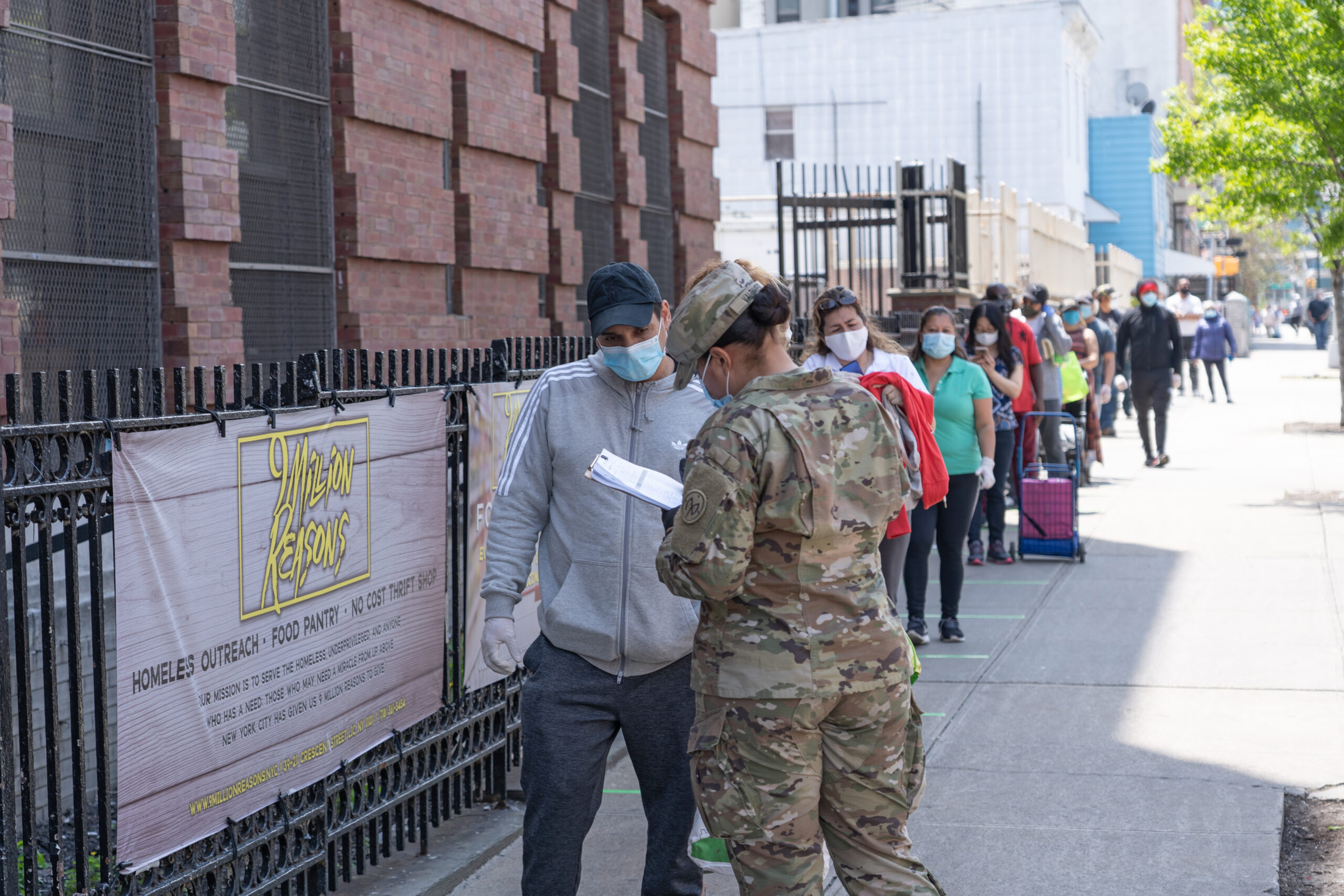
For organizations working on the front lines of food insecurity, the issue raises both operational and ethical questions. New York City’s emergency food network, comprising hundreds of community-based pantries, soup kitchens, and meal programs, has historically prioritized accessibility, anonymity, and dignity. The introduction of identification requirements could alter that framework in ways that would negatively impact intake procedures and other administrative processes, such as the day-to-day intake, record-keeping, and service logistics that allow pantries to function. Many food pantries rely heavily on volunteers, and few organizations have the infrastructure necessary to verify identification documents or determine eligibility under complex federal guidelines. Therefore, organizations may have to face difficult decisions about whether to invest limited resources in compliance systems or reduce the scope of their services.
National research suggests that identification requirements might disproportionately affect the roughly one in five food pantry users who are immigrants or children of immigrants, many of whom rely on emergency food programs precisely because of their limited eligibility for federal benefits.
The situation in New York City provides an especially important case study. Despite its status as one of the wealthiest cities in the world, New York faces a persistent food-insecurity challenge. Prior to the COVID-19 pandemic, an estimated 1.2 million New Yorkers experienced food insecurity annually, and that number has now risen to 1.4 million. While emergency federal programs introduced during the pandemic temporarily reduced hunger rates, the expiration of many of those programs has once again placed pressure on the charitable food system. Community organizations have been reporting a rising demand in recent years for pantry services driven by high housing costs, inflation in food prices, and the fact that wage increases in the low-income sector have not kept up with the increased costs of living.
In a recent article published by the New York Daily News, Molly Wasow Park, Commissioner of the New York City Department of Social Services, warned that recent federal policy changes could further strain this already overburdened system by restricting access to essential services, and urged state and local action to protect the city’s safety net for all residents, regardless of immigration status.
Food pantries and soup kitchens fill the gaps left by government nutrition programs such as the Supplemental Nutrition Assistance Program (SNAP). Unlike federal programs, however, the charitable food system has historically operated with minimal documentation requirements. Many organizations intentionally avoid collecting identifying information, both to reduce barriers to access and to protect the privacy of individuals who may be wary of government systems. While public benefits programs such as SNAP provide critical support, charitable providers play a complementary role by addressing immediate needs and reaching individuals who might fall outside eligibility criteria.
Populations Most at Risk
Advocates argue that these operating choices are essential for reaching populations who might not otherwise get the help they need. Undocumented immigrants, individuals experiencing homelessness, people leaving incarceration, and survivors of domestic violence are among those who often rely on emergency food providers precisely because they do not require identification.
Researchers have also documented what is often referred to as a “chilling effect,” which, in this instance, means that immigrant communities avoid services out of concern that participation could affect their immigration status or lead to data sharing with federal authorities.
Food assistance providers worry that identification requirements could amplify this effect, even among individuals who are legally eligible for services, and that the result could be an increase in hidden hunger, particularly among mixed-status households.
Cheryl Huber, Vice President for Food and Benefits Access at United Way of New York City, acknowledges that “everyone deserves access to food – as a basic human need and right, not a privilege. Policies that require identification at food pantries and soup kitchens risk creating barriers for New Yorkers who are already struggling, and sometimes in crisis. At UWNYC, our network of emergency food providers is expected to serve anyone who needs help, without requiring identification or personal information that could jeopardize their safety or sense of security.”
Huber also noted that “Emergency food is a last resort for those with no other way to access food, especially vulnerable populations like immigrants, seniors, individuals experiencing homelessness, and families in crisis. In 2025, emergency food programs in NYC saw 47.5 million visits, representing an 87% increase since 2019. Requiring ID would increase administrative burdens and slow service, limiting the ability of pantries and soup kitchens to respond to rising demand and ultimately increasing food insecurity by leaving more people without access to food.”
And Greg Silverman, Chief Executive Officer of the West Side Campaign Against Hunger (WSCAH), agrees that the introduction of ID requirements could fundamentally alter the way emergency food programs function, noting that WSCAH serves thousands of New Yorkers each month through a model that brings food closer to where people live and work by partnering with community organizations. The program is designed to support less travel in an age when ICE looms large, and it operates with minimal barriers to entry, a principle that reflects both practical and ethical considerations.
Silverman emphasizes that many individuals who seek assistance may not possess government-issued identification or may feel uncomfortable presenting it. In some cases, documents may have been lost due to housing instability. In others, individuals may fear that providing personal information could expose them to immigration enforcement or other legal risks. Even the perception of surveillance, he explains, can deter people from seeking help.
If identification becomes a requirement, Silverman warns that the consequences may extend beyond the individuals who are directly excluded. Demand for emergency food services tends to fluctuate in response to economic pressures. When barriers increase, the result is often not a reduction in need but a shift in where and how individuals attempt to access food. Some may turn to smaller informal networks, while others may go without assistance altogether.
National Context
Across the United States, the charitable food system has expanded significantly in recent decades. Food banks and community pantries now distribute billions of meals each year, forming an infrastructure parallel to government nutrition programs. And many of them strongly emphasize dignity and accessibility, principles that could be challenged by new eligibility verification requirements.
Advocates argue that treating emergency food programs as public benefits risks imposing eligibility restrictions on services that were never designed to function as traditional government welfare programs.
At the same time, disparities among states could emerge. Jurisdictions that do not pursue legal challenges may see the policy implemented sooner, potentially creating inequality in access to emergency food services across the country. In communities with less staffing capacity, the administrative burden of compliance could even lead some programs to close.
Supporters of stricter verification requirements argue that taxpayer-funded programs should ensure that resources are directed to eligible recipients, while critics counter that food pantries distribute donated goods and surplus food and are guided by a mission of community care rather than eligibility-based assistance.
What Happens Next
For now, the preliminary injunction ensures that, in New York State, food pantries, nonprofit organizations, and city officials can continue to operate while continuing to monitor the legal process and prepare for a range of possible outcomes.
Some organizations are exploring whether alternative documentation methods or community-based verification systems could help maintain accessibility if federal rules ultimately take effect. Others are focusing on contingency planning to ensure that vulnerable populations continue to have access to food assistance.
As the legal debate continues, advocates emphasize that the core issue remains unchanged. Food insecurity affects millions of Americans, including many residents of New York City. Policies that influence how people access basic nutrition, therefore, carry implications for the everyday lives of those struggling to make ends meet.