
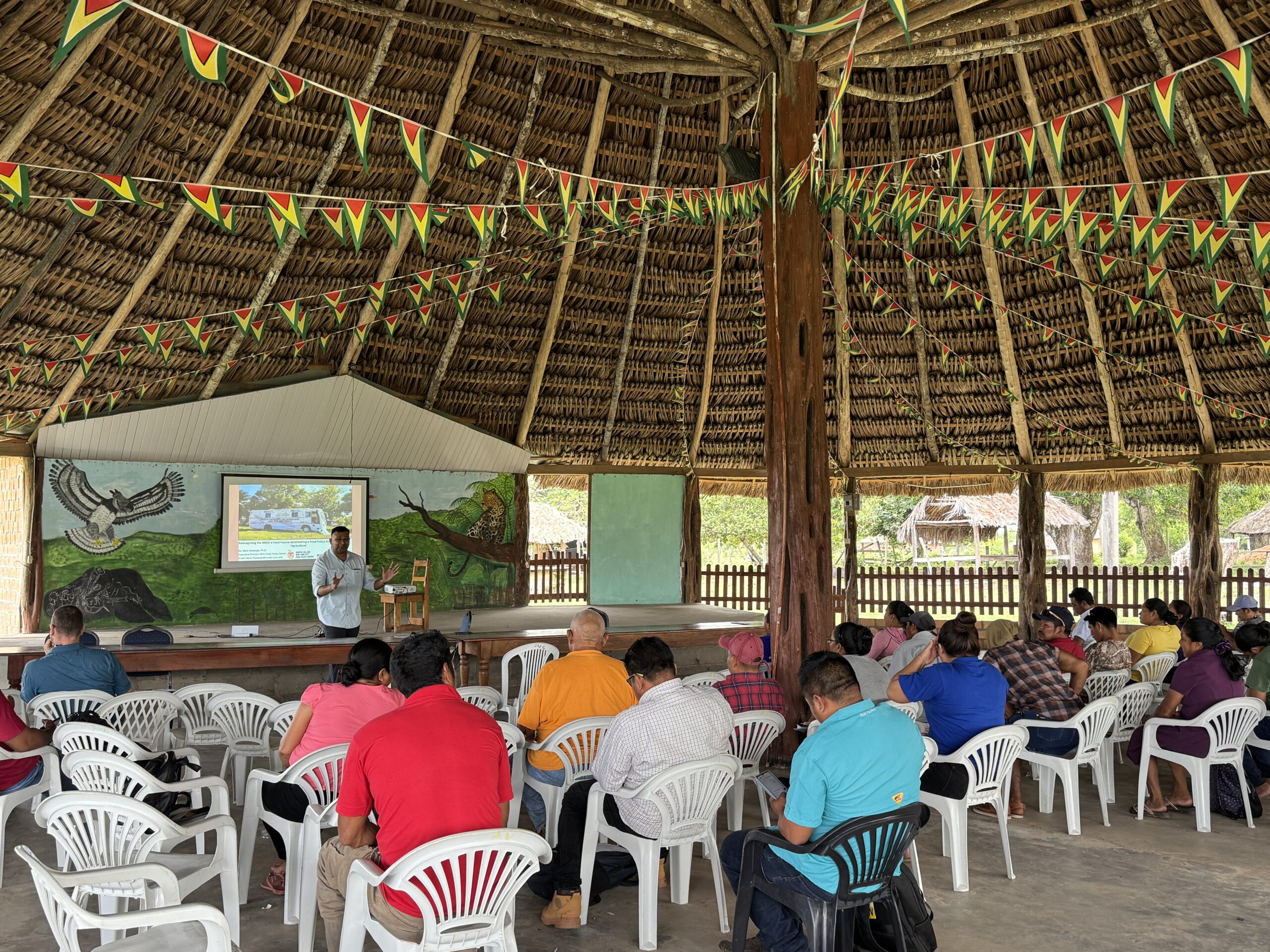
On February 9, 2026, leaders, Toshaos (too-SHA-ohs), technical experts, and invited partners convened in Aishalton, Guyana, for the third day of the South Rupununi District Council (SRDC) agricultural development meeting. The session marked an important moment of collective reflection and planning for the future of the region’s food access and production. Representatives from the New York City Food Policy Center participated as technical partners in the dialogue, contributing comparative policy expertise, facilitating structured discussions, and learning directly from community leadership about local priorities, pressures, and aspirations. Across the day’s exchanges, one theme remained consistent: the future of food systems in the South Rupununi must be community-driven, bottom-up, culturally grounded, and withstand aggressive external pressures.
The SRDC is the legally recognized collective representative body of twenty-one primarily Wapichan communities in Region 9, Guyana. Established formally in 2017 under the Amerindian Act, the SRDC brings together elected Toshaos (village leaders) and community representatives to coordinate collective decision-making across Wapichan Wiizi, the ancestral territory of the Wapichan people. The Council works to secure and sustainably manage traditional lands, advocate for full recognition of Indigenous land rights, and support village councils in community development, natural resource governance, and food security initiatives. They also implement territorial monitoring, cultural preservation, and programs supporting the transfer of traditional knowledge to younger generations, reflecting the SRDC’s broader mandate to protect the environment, strengthen Wapichan families and communities, and uphold the self-determined governance of the Wapichan people.
Reimagining the Region’s Food Future
The Food Policy Center’s contribution helped frame food policy not simply as an agricultural issue, but as an integrated governance tool linking health, culture, land rights, markets, and environmental stewardship. Dr. Mark Chatarpal, Executive Director of the New York City Food Policy Center, delivered a presentation titled “Reimagining the SRDC’s Food Future,” that helped shift the discussion from risk assessment toward a proactive system design. In this context, “food future” refers to the long term vision for how food is grown, distributed, and consumed in the South Rupununi. Drawing on the Center’s applied food policy work, Dr. Chatarpal introduced key conceptual distinctions between “food security” and “food sovereignty,” an intervention that sparked meaningful discussion among community representatives and participants.
Participants noted how conventional definitions of food security can be too narrow, where they focus on caloric access rather than cultural appropriateness, community control over food production and distribution, or ecological sustainability. In contrast, food sovereignty was widely viewed as more aligned with Indigenous priorities, emphasizing self-determination, traditional knowledge, and rights-based governance. This framing resonated strongly with SRDC leadership and helped advance discussion toward a more holistic policy pathway.
Village-Led Development and Youth Engagement
A key takeaway was the strong preference for bottom-up, village-driven planning that the FPC strongly encouraged. Participants agreed that top-down agricultural models have historically failed to reflect local realities. Instead, the proposed pathway forward would begin at the village level, building a district-wide framework through consultation, participatory mapping, and processes that place villages in direct control of their own food systems and supply chains.
Participants also emphasized the urgent need to create meaningful spaces for youth engagement. Ideas such as a South Rupununi Food Festival, a youth conference, or food calendar were proposed as mechanisms to build pride in traditional foods while fostering innovation and intergenerational knowledge exchange. The Food Policy Center signaled its interest in supporting youth-focused skills and leadership development and knowledge-sharing initiatives by outlining student engagement pathways and collaborative programming that would build the next generation of Indigenous food systems leaders.
Free, Prior, and Informed Consent (FPIC) as a Foundational Principle
Throughout the meeting, participants repeatedly emphasized the importance of embedding free, prior, and informed consent into development decisions and Indigenous food policy processes. Leaders stressed that, as foreign investors’ interests in the South Rupununi grow, FPIC must serve as a non-negotiable safeguard to ensure communities retain full authority over activities affecting their lands, food systems, and cultural practices.Their concern reflects broader national dynamics; in recent years Guyana’s rapid economic expansion has attracted increased attention from international investors, including major Chinese firms that are encouraged by the government to support the country’s “development and transformation.” Officials have publicly welcomed cooperation and additional foreign investment across multiple sectors, including oil production and infrastructure development. While these investments present economic opportunities, SRDC leaders emphasized that without strong FPIC protections, this intensified external interest could accelerate land pressures, reshape local food systems, and sideline Indigenous decision making.
Participants emphasized that FPIC is not merely a procedural checkbox but a core expression of Indigenous self-determination. In the context of the South Rupununi, this means consultations must be culturally appropriate: conducted in local languages when needed, respectful of village leadership and protocols, and inclusive of elders, women, and youth, collected data must be transparent and accessible, and villages must have adequate time and autonomy to deliberate collectively before any agreements are made.
The New York City Food Policy Center underscored that embedding FPIC early in the Indigenous food policy process will be essential to building a durable, rights-based governance framework. The Center committed to helping create clear tools and processes that allow communities to exercise free, prior, and informed consent as the partnership moves forward.
Toshaos and village participants broadly agreed that putting FPIC into practice through community-led decision making and ongoing monitoring would be essential to protecting land rights and advancing food sovereignty. By embedding FPIC at the outset, the SRDC aims to establish a governance model that places communities in control of how development is shaped and implemented.
Building Capacity for Indigenous Food Policy
Dr. Chatarpal outlined a proposed multi-year roadmap for developing an Indigenous food policy through a structured theory of change process with the New York City Food Policy Center providing technical accompaniment and capacity-building support, including policy training, research partnerships, and hands-on guidance in implementing the food policy framework. The approach would proceed village by village, incorporating monitoring and evaluation, train-the-trainers programming, and research partnerships between the SRDC and the NYC Food Policy Center designed to strengthen village autonomy and local policy stewardship.
There was strong support for establishing a South Rupununi Food Policy Council, intentionally avoiding the narrower term “agriculture,” to reflect the social, cultural, health, and environmental dimensions of the Indigenous food system governance and food sovereignty efforts. The Food Policy Center indicated its readiness to support the Council through its access to and experience with policy analysis, training opportunities, student research collaborations, and the convening of an Indigenous Food Policy Summit in New York City.
A Collective Path Forward
Overall feedback on the day’s discussions was highly positive, with widespread enthusiasm for next steps. There was broad agreement that an immediate priority will be defining what food security and food sovereignty mean within the South Rupununi context, recognizing that each village may hold distinct perspectives that must be respected and incorporated into the process. One participant reflected on the broader implications of the discussion, noting, “I think from the presentation that this really opens up our minds a little on a bigger scale. This is something we can definitely go in depth on and bring back to our villages.” Another participant emphasized how developing an Indigenous food policy could strengthen local decision making, “The government now tells us what we have to do, saying, ‘This is what we know will work for you.’ If we develop our own policy we can say, ‘No, we know what we want.’” These reflections captured the spirit of the meeting and showcase a growing momentum toward community driven food governance.
The February 9 meeting in Aishalton marked more than a technical planning session; it represented the early stages of a collective movement to reassert Indigenous leadership over the region’s food future. By centering cultural values, ecological stewardship, youth engagement, and FPIC-based governance, the SRDC and its partners, supported by the New York City Food Policy Center, are laying the groundwork for Indigenous food policy that could become a model far beyond Region 9.
For the New York City Food Policy Center, this partnership reflects a deepening commitment to South-South collaboration, Indigenous food sovereignty, and community-led policy design. The work ahead will require sustained engagement, careful listening, and continued capacity building. Yet, the direction is clear: the South Rupununi is not simply responding to external development pressures, but is actively defining its own food policy development for generations to come.