
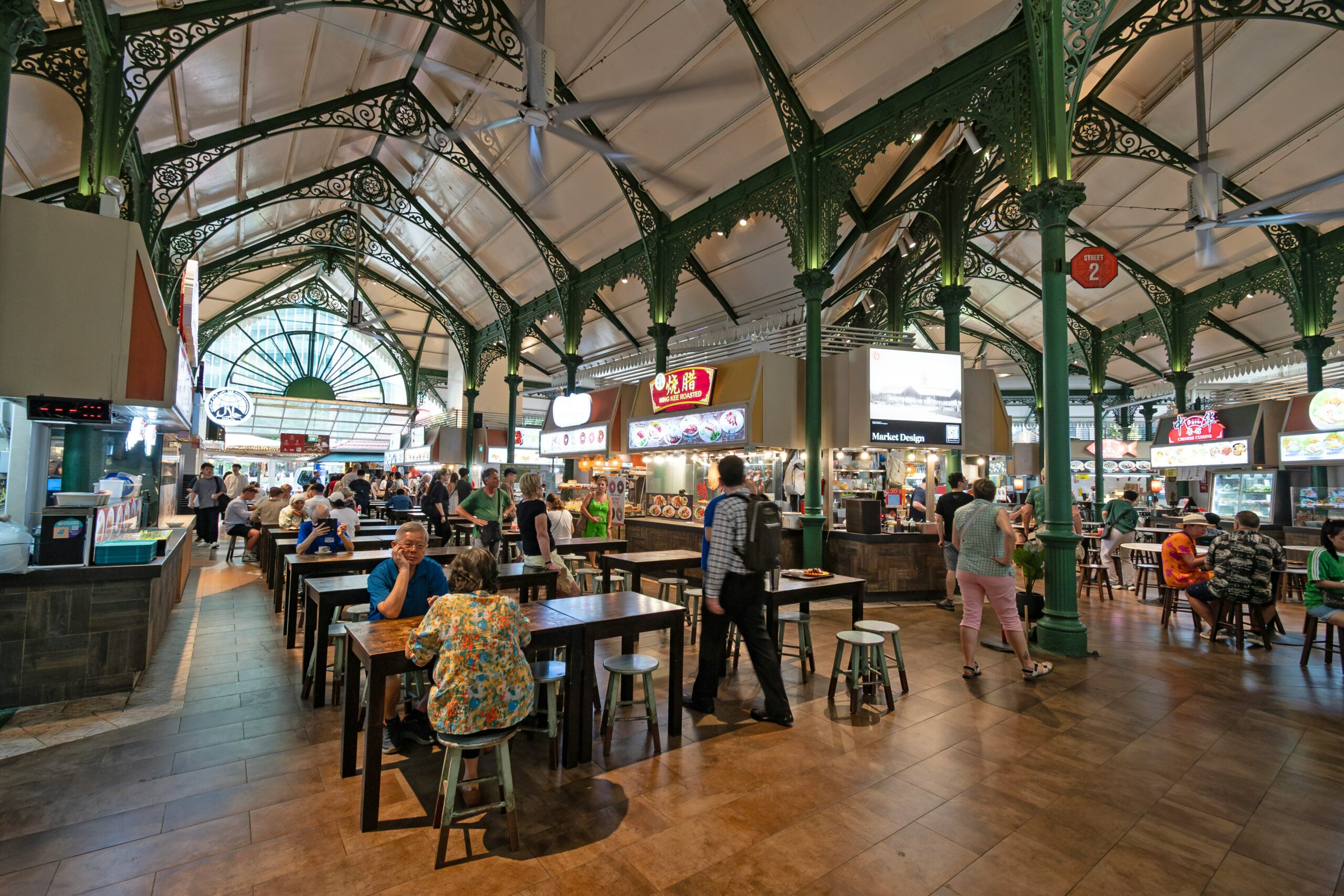
I first visited Singapore in 2015 and immediately fell in love with its hawker centres. I’d never seen anything quite like them. Unlike the shopping mall food courts I’d grown up with in the U.S., filled with chains like Auntie Anne’s, hawker centres are typically made up of independently owned, often family-run, stalls offering prepared foods from noodles and flatbreads to chewy pancakes and fresh soy milk. Yet they are all housed in permanent, open-air structures rather than parked streetside like the vendors I’d eaten at across Asia. But it wasn’t just the rows of good food that drew me to hawker centres, but the clear level of state investment, oversight, and sustained attention to this style of public dining. As far as I have experienced, such depth of investment in a public dining infrastructure is unprecedented anywhere in the world.
I spent that first trip bouncing from centre to centre, eating with both my eyes and stomach. From well-known favorites like poached chicken rice and nasi lemak (coconut rice, typically served with fried chicken and pickles) to lesser-known dishes like lor mee (a noodle dish in sticky beef gravy) and mua chee (a sweet and savory soft mochi), every meal held the excitement of unwrapping gifts on Christmas morning. I still remember eating a bowl of handmade fishball noodles at Hong Lim Hawker Centre at 7:00am, slightly feral from being jetlagged and awake since 3:00am, thinking: Mark my words, I’ll be back soon.
And I was. I returned in 2023 as a Fulbright Scholar and National Geographic Explorer, supported by a fellowship to research hawker centres with the National University of Singapore. After two years of fieldwork, which included semi-structured interviews with 22 hawkers across Singapore, I found that the city-state has been actively intervening in its hawker trade since before the country’s formal existence. The government deliberately took on the task of first registering and licensing its roving street vendors, then relocating them into permanent centres in the 1960s and 1970s to improve regulatory, health, and sanitation measures. Yet, I still couldn’t find the answer to one lingering question: If hawker centres were built to both feed and offer a means of livelihood for Singapore’s working class, whose interests do today’s preservation policies actually serve?
Form vs. Function: A Question About Policy Priorities
In 2020, Singapore became the first country to earn UNESCO Intangible Cultural Heritage recognition, specifically for its hawker culture. It was an important milestone, serving as a formal acknowledgment that these spaces operate as community and social infrastructure, not just public dining halls. However, the formal recognition did not fundamentally address the priorities for preserving what the Singaporean government repeatedly calls “hawker culture.”
Today, the median age of a Singaporean hawker is 59. Stall after stall is shutting down due to persistent issues such as high costs and younger generations’ lack of interest in taking over their family businesses. In today’s economy, being a hawker no longer pays like it once did. Nearly every hawker I spoke with expressed some version of the same frustration: being celebrated as a cultural steward while struggling with the necessary labor flexibility and financial protections that would make the trade more sustainable and lucrative as a career. In fact, many anticipated that a near-total collapse of the hawker industry would occur within ten years.
I find it useful to evaluate these hawker centres’ looming collapse through two lenses: “form” and “function.” Form is what we can see, touch, and smell—open-air layout, communal tables, compact stalls, and a particular ambiance at each centre that gives it a special place in locals’ hearts (and stomachs). Function is what the hawker centre does—providing affordable meals, enabling accessible entrepreneurship, and serving as a third space that is free to enter and conveniently located for all between home and work.
Yet, these two lenses are not always compatible, and policies that try to serve both without prioritizing either often end up producing contradictions. For example, in an effort to keep hawker prices low enough to serve as what one official famously called “good quality meals at almost Third World prices,” hawkers have struggled to offset rising rents, ingredient costs, and fees for cleaning, digital payments, and delivery platforms. As the government continues to build new centres and renovate older ones, streamlining operations such as stall buildouts and centralized dishwashing can mean trading in some of the unique aesthetics of each business that contributed to the sense of character for each location. The result is a preservation effort that, in trying to protect everything, risks losing what made these centres Intangible Cultural Heritage in the first place.
Policy Disconnects Between Intention and Impact
1. Mandating Affordable Food Without Controlling Costs
The expectation that hawker food should be cheap has deep roots, starting with government policy itself. In the 1940s, the Singapore Department of Social Welfare launched a communal feeding program with the explicit aim of lowering the prices of prepared food and countering what they called “profiteering street hawkers.” The good news is that the program worked: restaurants and other prepared food options observably lowered their prices afterward, or increased portions for the same price. The bad news is also that the program worked: even though it’s long gone, the demand for food that offers high value at low prices has not.
Today, the economic realities of operating a hawker stall make it very difficult to meet this expectation. Rent is one of the major fault lines. Due to legacy subsidies, pioneer-generation hawker families—those who began as street vendors and were relocated to hawker centres—can pay as little as SGD $150–$200 per month. However, new entrants at the same centres must bid for stalls, facing market rates of SGD $2,000–$5,000. Even for multi-generational hawker families who entered the market after the pioneer generation, direct family inheritance doesn’t protect them from paying market rent. This creates a dynamic where one set of hawkers can undercut others indefinitely, pricing their dishes at SGD $2 to $3 to make a slim profit, while others must start at SGD $7 or more. Unsurprisingly, new entrants facing such a competitive disadvantage often exit the trade entirely.
In 2024, a record SGD $10,000-plus monthly bid was placed for a stall at Marine Parade Market. This prompted an important and overdue public debate about the existing open tender system for hawker centre stalls. If hawkers are meant to provide affordable food as a social safety net for Singaporean workers, why allow market-rate rents that make it nearly impossible for hawkers to price their dishes so they can still make a profit? If the function of the hawker trade is meant to be accessible to any working-class Singaporean, what should be done about a system that effectively favors those with access to institutional capital?
Things are not necessarily rosy for the pioneer-generation hawker families, either. Existing rental policies have encoded a phased elimination of this longstanding subsidy: the low rent can only be transferred to direct next of kin. In the case of one of my interviewees, the great-grandniece of a pioneer hawker, she cannot inherit the subsidized rate and thus needs her grand-aunt to stay the formal owner of the stall to delay the rent increase. A separate policy also mandates that hawker stall owners must be physically present at their stalls, thus forcing her elderly grand-aunt to continue working. In many of these pioneer-generation hawker families, this rent differential is a make-or-break for their bottom line. When I asked one such hawker whether their business would survive at market rates, the answer was a flat “No.”
Meanwhile, ingredient costs have risen across the board. One fried carrot cake hawker told me eggs—a key ingredient for their dish—have risen 66% since 2017. Separately, a pig organ soup hawker recalls that the price of pig intestines more than doubled in the same period.
Compounding the issue is that hawker stalls are so small: centres built before 1985 range from 5 square meters to 13 square meters. Without the storage space to buy in volume, hawkers are shut out of volume discounts for their raw ingredient purchases, with many paying retail rather than wholesale prices, which further erodes already thin margins. As a result, hawkers are pushed towards less-than-ideal alternatives, such as sourcing cheaper ingredients, swapping fresh, whole produce for canned or pre-cut, and increasingly turning to heavily processed substitutes like frozen, pre-fried chicken cutlets, pre-marinated meats, and mass-produced sauces for what was once made fresh in-house. This is the opposite of preservation; it is the slow hollowing out of the very food culture the UNESCO designation was meant to protect.
2. Promoting Entrepreneurship While Undermining Viability
Singapore’s hawker centres were built on the premise that any Singaporean could enter the trade, make a decent living, and meaningfully contribute to the country’s food culture. The government has leaned heavily on this narrative in recent years, committing to building 10 new hawker centres by 2027 to expand access and preserve the trade. But hawkers on the ground tell a different story.
One had asked me, “Why are they building more hawker centres—mega hawker centres, two, three stories? How are we older hawkers supposed to compete?” Another pointed to Chinatown Complex Hawker Centre, with its 226 stalls, many of which are currently empty, as an example of how adding new stalls without addressing the underlying supply problem does little to improve the hawking industry.
The new centres also introduce a structural conflict that is reshaping what hawker culture looks and feels like from the inside. Singapore introduced a new SEHC or Social Enterprise Hawker Centre model when it resumed building hawker centres in 2011, in which private, for-profit companies such as Kopitiam, NTUC FoodFare, and Timbre Group are appointed to operate hawker centres with a “social mission.” However, how exactly that “mission” is defined by the state has remained notably vague. Despite this, fourteen hawker centres currently operate under this model. There, SEHC operators can mandate a budget meal option—typically $3.50 or under—and require all hawkers to use the operator’s point-of-sale system, giving the operator full visibility into every stall’s sales data. Multiple hawkers told me they lose money on every budget meal sold but must comply to keep their stalls.1
Other vendors have noted that operators use sales data to launch their own competing stalls within the same centre and undercut the very hawkers they oversee. As one interviewee told me, “I cannot sell the same food as other people, but you [as the operator] are also doing the same thing. That doesn’t make sense.”
The cumulative effect is a homogenization that hawkers find deeply troubling. Chains and franchised concepts are increasingly filling new centres, able to access volume discounts, absorb losses, and generate foreign work permits that independent operators cannot. In particular, the source of labor is a point of contention at hawker centres. In an effort to protect the “local identity” of the hawker trade, hawkers can only hire Singaporean citizens or Permanent Residents (PRs) to work in their stalls.2 However, the realistic wages they can offer simply do not attract many interested workers. One hawker I interviewed even offered $4,000 SGD monthly and still could not fill a support role. The workaround many have landed on is expanding into private kopitiams or shopping mall food courts. It is a solution that, by design, draws investment away from the hawker centres the government is trying to fill—and further concentrates hawker presence in privately run, commercially oriented spaces.
The policy response to the labor shortage has largely bypassed its root cause. New government grants like the Hawkers’ Productivity Grant offer financial offsets for implementing machine automation for certain production tasks, but much of the pre-approved equipment is too large to fit in the stalls and is an inadequate substitute for human artisanship. As one curry puff hawker told me: “What hands can produce is different from what a machine can produce.” While mechanization may improve efficiency, it does not preserve craft as a tradition.
Government training programs tell a similar story. Of the 566 people who completed the Hawkers’ Development Programme to promote new hawker ventures, only 16 stalls remained operational as of 2025. The earlier Hawker Master Trainer Pilot Programme, with similar goals, concluded in 2014 with 13 completions and 2 operational stalls. These numbers are not an anomaly: they reflect a system that asks people to join a trade that is no longer viable to enter.
3. Complex Rules, Unclear Accountability
The outsourcing of hawker centre management doesn’t stop with SEHC operators. Cleaning services are also subcontracted, and hawkers bear the cost regardless of whether the service is actually delivered. Fees start at $400 SGD monthly for basic unwashed tray and utensil return and rise to over $1,000 for those who may opt into dishwashing (only available at newer centres). This amount is charged to hawkers regardless of actual usage—as one coffee hawker mentioned, they must pay the return fee even though they use only disposable wares.
The subcontracting model further creates a familiar dynamic in which companies bid low to win contracts, then underdeliver with minimal consequences. An interviewee recalled that their centre was contractually promised 30 to 40 cleaning workers at any given time, but regularly receives only around 10. While the hawkers I interviewed wanted to complain, they often held back, knowing many of the cleaning workers are elderly and low-income. Several, I was told, are unhoused and sleep in the centres they clean overnight. The result is a legitimate grievance with no outlet, as hawkers know that complaining about the service means directing frustration at workers who are just as trapped in the system as they are.
The deeper problem is that, as more parties have been added to the management chain, hawkers have become less clear about who is actually responsible for what. When the Singapore Food Agency (SFA) was carved out to take over food hygiene responsibilities previously held by NEA, it created a jurisdictional puzzle for hawkers to navigate. For example, as one hawker described their experience with pest control: “If it’s pests inside your shop, it’s under this agency. If it’s outside your shop, it’s under another agency. But the pests run everywhere.”
This fragmentation also leads to inconsistent enforcement of the ever-increasing rulebook that hawkers face. One hawker tells me they operated for eight months without ever receiving a hygiene letter grade, while another has been waiting a decade-plus for exhaust system repairs. While one hawker was fined several thousand dollars for keeping their stall closed for an extra week due to a staffing shortage, other stalls in another centre remained dark for months without any apparent consequences. As a result, hawkers have learned that giving feedback upwards risks triggering standardized enforcement. A new hawker recalled that a veteran told them upon opening, “Never complain about anything, because otherwise they’ll make everyone follow all the rules.”
The formal channels for raising concerns offer little reason to behave otherwise. Each centre relies on a volunteer Chairperson—also a hawker with their own stall to run—to field complaints and relay them upward. Above them sits the Federation of Merchants’ Associations Singapore (FMAS), a non-profit that liaises with NEA on hawkers’ behalf, but only a fraction of Singapore’s 114 centres have associations affiliated with FMAS, and neither body holds formal policy authority or enforcement leverage. When the system does respond, it is not always with good faith: when one hawker asked whether additional storage space might be possible, the NEA officer’s reply was contemptuous: “Do you want me to open a restaurant for you?”
What Hawkers Actually Want
By this point in my research, I kept asking myself the same question: why do hawkers stay?
Interview after interview, hawkers resoundingly said the same: they persist because, as one put it, “I’m owning a part of Singapore history. And I hope the government really sees us as a part of history.” Hawkers are not just food vendors. They are, in a very real sense, performing a national service by ensuring affordable food remains available to the masses, preserving the region’s unique culinary knowledge, and sustaining the social fabric of neighborhoods. And their level of stewardship deserves reciprocation.
Singapore has an important opportunity right now. It has a UNESCO designation, a government with the ability and capacity to act, and a generation of hawkers who still want the trade to survive. Effective preservation should not require hawkers to choose between heritage and economic reality. Instead, it asks for acknowledgment that culture cannot be sustained without caring for the people behind it. The hawkers I interviewed are not asking for the industry to be frozen in time. They are asking for policies that let them do their jobs, earn a living, and pass on what they know.
Define the goal. Before any specific policy can be set, the government needs to state clearly what it is trying to preserve, be it culinary knowledge, affordability, access to entrepreneurship, physical form, or some combination, and design around that hierarchy explicitly. Without it, interventions will keep working at cross-purposes. Take, for example, the fact that only a small subset of local fare is publicly promoted as “hawker food” by the National Heritage Board, thus driving interest and demand specifically to those dishes. As one hawker cooking fusion food told me, “If you go to every hawker centre [and] you [only] see chicken rice, nasi lemak, oyster omelet. That, to me, is the dilution of hawker culture.” Form and function, heritage and viability, tradition and innovation—these tensions do not resolve themselves.
Involve hawkers meaningfully. Existing consultation mechanisms lack authority. Even hawkers who participate in government-run focus groups have no veto power, no accountability measures, and no way to track whether their input was incorporated. Real co-governance means hawker representation in policy design, transparent criteria for rental valuation, and structured channels for raising operational concerns.
Right now, the official depiction of hawkers’ livelihoods does not capture important nuances. For example, NEA surveys in 2014 and 2018 concluded that hawker cost structures had “remained the same”. But the pig organ soup hawker, who was interviewed as part of the survey, recounts that when officials visited their stall and asked about ingredient costs, they refused to include water—a key ingredient in soup—as a food cost input. Despite this hawker’s utility bills having risen by 200-300% over several years, this cost increase didn’t make it into the final analysis.
Redesign the rental system. The current structure, which simultaneously subsidizes some vendors indefinitely while pricing out new entrants, fails to satisfy any coherent policy goal. While hawkers were divided on how exactly rents should be set, it was clear from my interviews that no one understood what determined the current “market rates.” Additional transparency into this process is direly needed, as is access to rental subsidies and consideration of merit-based criteria beyond ability to pay. As one hawker suggested, if there are too many competitors for a subsidized stall, “go by food tasting [instead].”
Extend basic protections. Hawkers receive no business interruption pay during mandated centre closures, no income support during health emergencies, and face retirement with minimal savings because contributing to a voluntary retirement each month is an unrealistic ask for those already struggling to break even. The 2024 Platform Workers Act recognized similar vulnerabilities among gig workers and mandated employer contributions and injury insurance. Hawkers, who have contributed to national identity in incomparable ways, deserve at least the same.
This article draws on two years of fieldwork conducted in Singapore under a Fulbright-National Geographic fellowship, including semi-structured interviews with 21 hawkers conducted between October 2024 and July 2025, following approval by the National University of Singapore Institutional Review Board. All quotes are anonymized per IRB protocol.
Jenny Dorsey is a professional chef, food writer, and researcher who studies food as the foundation for human meaning-making and identity formation. She holds a Master of Education from Harvard University and just finished her Fulbright-National Geographic Fellowship in Singapore, researching food policy in the context of hawker centres. Jenny is an IACP-winning photographer, James Beard Awards-nominated writer, and has been named an industry Game Changer by Food & Wine and a Trailblazing Activist by the World’s 50 Best. Her full biography, food portfolio, awards, and bylines are available at www.jennydorsey.co.
Cover photo by Scribbling Geek via Unsplash
- As of August 2025, some SEHC-run hawker centres will no longer require their vendors to offer budget meals due to public controversy. ↩︎
- A January 2025 policy update permits hawkers to hire Long-Term Visit Pass (LTVP) holders, but hawkers widely regard this as insufficient because LTVP holders are often spouses of higher-income Singaporeans unlikely to seek physically demanding hawker work. ↩︎